



 Hong Kong Can Do More to Make the RMB a Global Settlement Currency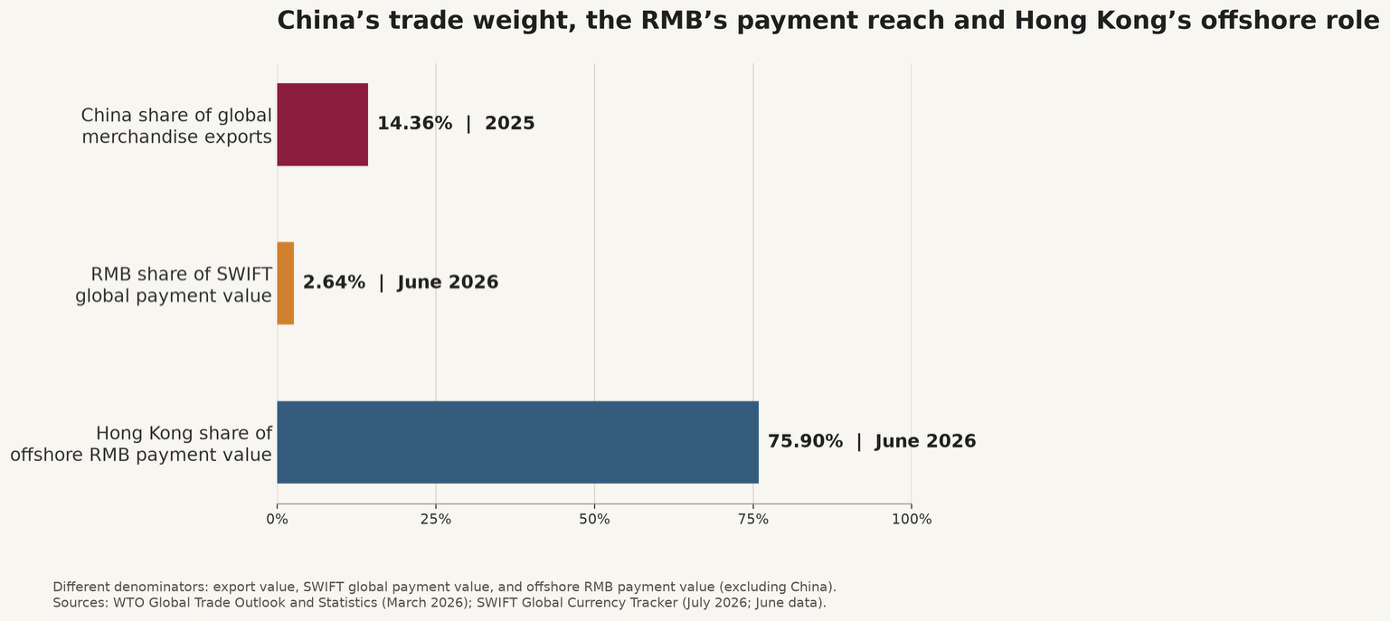
Chart note: the three figures use different denominators—global merchandise-export value, SWIFT global-payment value, and offshore RMB-payment value excluding China. They are indicators of scale and reach, not a like-for-like currency-demand ratio. [3] [4]
(Yicai) Sept. 30 -- The question for Hong Kong is not whether it can unseat the dollar. It cannot, and need not try. The more relevant question is whether companies trading with China and across the global south will have a sufficiently liquid, hedgeable and well-governed alternative when a once-integrated trading system becomes more political and more regional.
That is a market-infrastructure question. It is also where Hong Kong has a rare opening. The city is already the principal offshore market for the renminbi. Beijing and the Hong Kong Monetary Authority have recently begun to add the plumbing that a global settlement centre needs. Financial professionals are returning as the city’s capital markets revive. Hong Kong’s next ambition should therefore be explicit: to become the global centre at which the renminbi can be converted, financed, invested and settled for trade beyond China.
The backdrop is not a foregone “de-dollarisation”. It is fragmentation. The World Trade Organization has warned that the trading system is at a critical juncture. In a scenario of competing geopolitical blocs, its economists estimate world GDP would be 5.1 per cent lower and exports 18.6 per cent lower by 2050 than otherwise. Reuters also reported that the WTO’s estimate of merchandise trade conducted on most-favoured-nation terms had slipped to 72 per cent, from roughly 80 per cent in 2022. [1]
“The rules are under strain and they really are having an impact.”
— Rob Staiger, WTO chief economist, speaking to Reuters [1]
Fragmentation does not mechanically create a new reserve currency. But it does make a single settlement channel a larger operational and political exposure. The World Economic Forum’s June report is properly cautious: it says the dollar remains the dominant reserve, invoicing and foreign-exchange currency. Yet it also sees signs of a more multipolar monetary system, driven by trade in which the US is not a party and by governments seeking to reduce dollar dependence and sanctions exposure. Its answer is interoperability, not the construction of walled-off payment blocs. [2]
The numbers underline both the dollar’s resilience and the renminbi’s opportunity. SWIFT’s July 2026 Global Currency Tracker, which reports June payments, puts the dollar at 58.63 per cent of global payment value and the renminbi at 2.64 per cent. SWIFT rightly cautions that its message-level statistics are not complete market statistics. Still, the hierarchy is unmistakable. [3]
China’s trade weight is much larger. The WTO puts China’s 2025 merchandise exports at $3.77tn, against world merchandise exports of $26.26tn. That is 14.36 per cent of the global total, calculated from the WTO figures, while the renminbi’s SWIFT global-payment share was 2.64 per cent. The comparison is not like for like—export share is not invoicing share, and SWIFT is not the whole payments market—but it illustrates the gap between China’s commercial reach and the currency’s usable international settlement footprint. [3] [4]
Hong Kong is where that gap can be narrowed. SWIFT assigns the city 75.90 per cent of offshore renminbi payment value, excluding China, in June. The Hong Kong government says offshore RMB lending reached a record RMB935bn in 2025, while RMB bond issuance hit RMB1tn for a second consecutive year. Those are not simply badge-of-hub statistics. They are the beginnings of the funding, collateral and investable-asset ecosystem that firms require if they are to accept RMB rather than immediately swap it away. [3] [9]
Recent PBOC–HKMA actions show that this agenda is moving from rhetoric to market design. On 11 June, the PBOC, HKMA and Bank Indonesia signed an MoU for direct Indonesian-rupiah/offshore-renminbi (CNH) exchange and settlement in trade and investment between Indonesia and Hong Kong. Eddie Yue, HKMA chief executive, called it a “major breakthrough in promoting regional currency and Renminbi use”. [5]
On 7 July, the two monetary authorities, with Hong Kong’s securities regulator, announced a broader package for fixed income, market connectivity and offshore RMB business. The HKMA’s RMB Business Facility was enlarged from RMB200bn to RMB500bn, with maturities extended as far as three years. Planned additions include a seven-day liquidity tender, offshore RMB short-dated instruments and work on an offshore yield curve. [6]
Pan Gongsheng, governor of the PBOC, added an important practical detail in July: the central bank’s new RMB repo facility for monetary authorities had completed its “first signing and first operation” with the HKMA. High-grade collateral, including Chinese government bonds, can therefore be used to secure RMB liquidity. Pan also said Hong Kong handled more than 70 per cent of global cross-border RMB transactions. [7]
The most recent operating step is less spectacular but revealing. A 23 September tender issued RMB60bn of six-month PBOC bills through the HKMA’s Central Moneymarkets Unit, for settlement on 28 September. Regular, credible supply of short-duration paper is precisely how an offshore currency develops a benchmark curve, collateral stock and money-market habits. [8]
Hong Kong should now press the advantage in four ways.
First, it should make the RMB500bn facility a global trade-finance utility rather than a local liquidity backstop. That means transparent eligibility, published operational terms, dependable market-maker obligations and the rapid launch of the proposed seven-day tender. A treasurer in Jakarta, Dubai or Frankfurt will use RMB only if funding is available when markets are stressed, not merely in a policy presentation.
Second, the Indonesia framework should become the template for a network of direct CNH conversion corridors, beginning with trading partners that have real two-way commerce with China. Each corridor needs appointed dealers, intraday liquidity, transparent FX pricing, hedging instruments and shared anti-money-laundering and data standards. A memorandum alone does not create a settlement market; a repeatable rulebook does.
Third, Hong Kong should join its payment ambition to a deeper RMB asset pool. Regular PBOC bills, larger and more varied Ministry of Finance issuance, repo against eligible bonds, exchange-traded hedging instruments and better links between Bond Connect, Swap Connect and the city’s RMB real-time gross-settlement system would give exporters, importers and banks somewhere safe to put RMB balances. Settlement and investment must reinforce one another.
Finally, the city should direct its returning human capital towards the less glamorous work of payments: operations, compliance, risk, FX-market making, cyber resilience and legal documentation. Reuters reported this month that financial-services professionals are returning to Hong Kong from Singapore, London, Dubai and mainland China, attracted by wealth-management and China-related opportunities. It cited Lee Brantingham of executive-search firm H.I.E.C. as saying that the influx was more than a cyclical rebound.
“Hong Kong is developing as a more China-integrated international hub.”
— Lee Brantingham, H.I.E.C., quoted by Reuters [10]
The report also said more than 400 companies set up local entities or expanded in Hong Kong in the first half of 2026, with expected creation of more than 8,600 jobs. That does not prove a permanent migration of global finance. But it is a timely supply of skills for an international settlement project that will need bankers and technologists as much as political sponsorship. [10]
Hong Kong cannot by itself decide the pace of RMB internationalisation. Capital-account policy, onshore convertibility and China’s broader macroeconomic choices remain Beijing’s domain. But that is precisely why the city’s task is clear: build the neutral, internationally legible market infrastructure that turns policy support into daily commercial use.
The prize is not a world without the dollar. It is a more resilient payments architecture in which an exporter, importer or investor can choose to hold, fund, hedge and settle in RMB without accepting a liquidity penalty. In an era when the trade system is dividing into more contested corridors, Hong Kong is better placed than any other centre to provide that option. It should act accordingly.
References
[1] Reuters, WTO says global trade system at critical juncture, urges reform, 15 September 2026
[2] World Economic Forum, Deepening Divides: The Cost of a More Fragmented Financial System, June 2026
[3] SWIFT, Global Currency Tracker: Monthly reporting and statistics, July 2026
[4] World Trade Organization, Global Trade Outlook and Statistics, March 2026
[5] Hong Kong Monetary Authority, Indonesia–Hong Kong local-currency settlement MoU, 11 June 2026
[8] CMU OmniClear / Hong Kong Monetary Authority, Result of tender of PBOC RMB Bills, 23 September 2026
[9] Hong Kong 2026 Policy Address, Chapter III: Global Offshore Renminbi Business Hub
[10] Reuters, Hong Kong draws back talent as IPO boom fuels financial hub’s revival, 11 September 2026
 Zhou XinZhou Xin is one of China’s most distinguished journalists, formerly one of the founders of Yicai Global; Chief Hong Kong correspondent for Shanghai TV; a business editor with CBN, and associate editor-in-chief of Caixin Media.