



 Second Chinese Ultra-High Voltage Power Line Project Seeks Private Funding
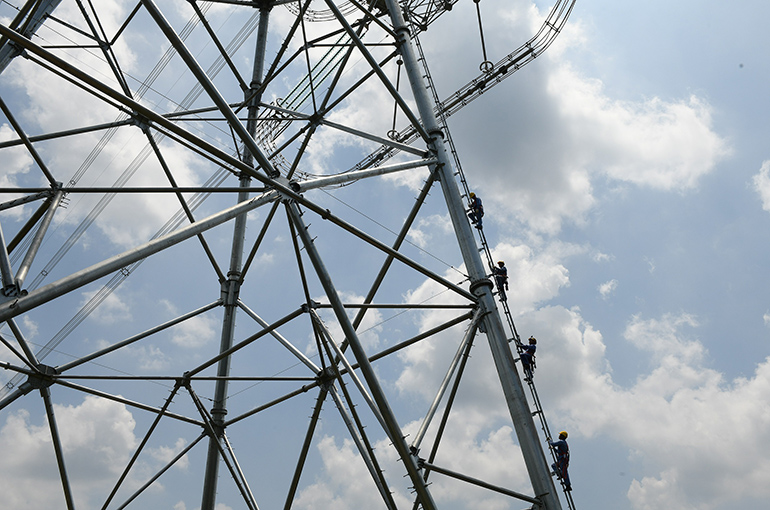
(Yicai) Feb. 10 -- China’s Xinjiang-to-Sichuan ultra-high voltage power transmission project, with planned investment of CNY31.1 billion (USD4.5 billion), has become the second such project to seek private investors in a sector long dominated by state money.
The power line project, which stretches from Ruoqiang in Xinjiang Uygur Autonomous Region to Mianyang in Sichuan province, is soliciting qualified private investors, with the governments of Xinjiang, Qinghai, and Chongqing -- three provincial-level regions along the line -- recently issuing separate notices seeking interest.
State Grid Corporation of China and qualified private firm will jointly set up a project company to oversee investment, construction, and running, with the private investors together owning about 10 percent, per the notices. The project has a 35-year operating period and the return on equity will likely be around 5 percent based on electricity pricing methodology approved by the National Development and Reform Commission.
Last month, the Gansu Provincial Energy Bureau likewise said it was seeking private investors for the Gansu-to-Sichuan ultra-high voltage transmission project, which will cost CNY24.6 billion. The line goes from Jiuquan in Gansu to Ziyang in Sichuan.
“Ultra-high voltage transmission projects have big investment needs and relatively stable returns, with a 5 percent rate attractive to some large private companies," a manager in the investment department of a central government-owned energy enterprise told Yicai. A "state capital-led, multi-party participation" model can improve project operating efficiency and provide private capital with predictable cash flow, he said.
In addition, the experience of building and running these projects can be applied to other large energy projects, such as pumped storage and distributed smart grids, the manager pointed out.
The Xinjiang-to-Sichuan and Gansu-to-Sichuan projects have clear eligibility criteria for private investors, requiring them to demonstrate funding capacity and credit/financing ability proportional to each project’s scale and have business operations relevant to the energy infrastructure sector.
China’s government encourages and supports private capital to invest in large energy infrastructure projects, including nuclear power, hydropower, cross-provincial and cross-regional direct current transmission channels, oil and gas pipelines, and imported liquefied natural gas receiving and storage facilities, according to a policy document issued by the General Office of the State Council last November.
Shareholding ratios can be determined based on the actual situation of the projects and the willingness of private companies, the document said. For qualified projects, the combined equity ratio for private capital can exceed 10 percent.
Twenty private businesses have joined newly approved nuclear power projects in the past two years, with their stakes raised to between 10 percent and 20 percent, Xu Xin, deputy director of the National Energy Administration's legal system and institutional reform department, noted in November. Investment by private firms in gas storage, oil and gas feeder pipelines, and terminal pipeline projects has also topped 10 percent, Xu added.
The Xinjiang-to-Sichuan line is about 2,000 kilometers long and will send wind and solar energy generated in the Taklimakan Desert to Sichuan, while the Gansu-to-Sichuan line is around 1,460 km and will transit wind and solar energy from the Badain Jaran Desert to Sichuan. SGCC is the majority shareholder in the two projects, with both expected to go live in 2028.
Editors: Tang Shihua, Martin Kadiev