



 WorldSkills Showcases Alternative Path to Good Jobs, UK Minister Says
(Yicai) Sept. 24 -- The WorldSkills Competition in Shanghai is helping raise the profile of vocational education by showing young people that skills-based training can lead to good jobs and promising careers, according to the United Kingdom’s minister of state for skills.
“WorldSkills demonstrates the levels of excellence that can be achieved in the UK through a skills route,” Jacqui Smith told Yicai during the ongoing 48th WorldSkills Competition, held in China for the first time. The UK wants technical and vocational education and skills pathways to have the same profile and standing as academic routes, she added.
Known as the “Olympics of Skills,” the WorldSkills Competition -- the largest to date -- will run until Sept. 27 in Shanghai, bringing together more than 1,300 competitors from over 60 countries and regions across 64 skills. The event tests young professionals in skills ranging from robotics, welding, and aircraft maintenance to cooking, hairdressing, and web development.
The event is like a big “skills melting pot,” bringing people from different countries together to meet and learn from each other, according to the minister responsible for the UK's skills policy, as well as technical and vocational education.
The UK and China can work together to develop skills systems that help young people find employment, fill skills gaps and support economic growth in both countries, she added.
Part of the interview follows:
Yicai: Could you briefly introduce the UK delegation and its key strengths at this year’s competition?
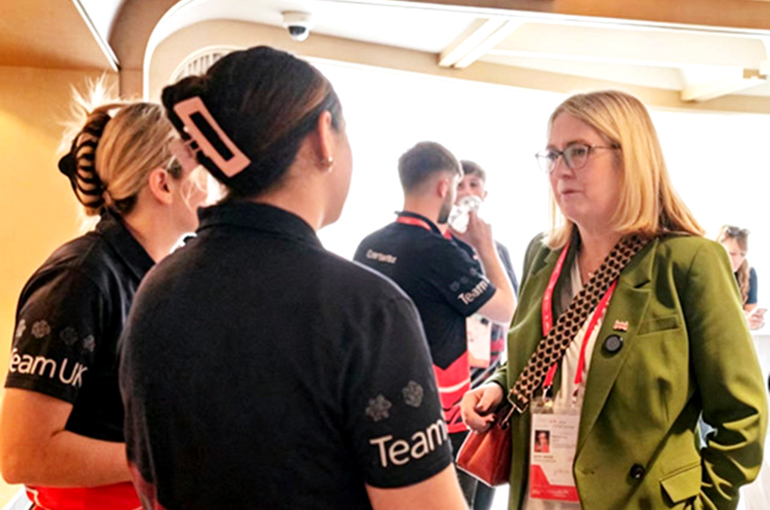
Smith: We're taking part in 25 competitions, and I've just had the opportunity to meet the team, some of whom I also saw in the European finals. They are all very enthusiastic and very much looking forward to the competition. The whole range of areas we're competing in demonstrates the breadth of the vocational education and skills system in the UK and the strengths we have across different fields. I was talking to somebody who's going to be doing beauty therapy. I was talking to somebody else who's doing robotics, chemical testing, engineering and bricklaying. It's a fantastic range of skills that are being showcased, not only by Team UK but, I suspect, by all of the teams in the competition.
They also come from different parts of the UK education system. Some of them have gone through university degrees or are doing university degrees now, while others are doing apprenticeships. Their employers are very proud that they are representing the UK here at WorldSkills. Others are doing what we call our Level 3 qualifications, like T Levels and V Levels. So they're demonstrating a wide range of skills, as well as the range of ways that the UK skills system supports people in developing skills in different areas.
Yicai: The UK has participated in WorldSkills for many years and has also hosted the competition. How does WorldSkills help attract young people to vocational careers and improve public perceptions of skilled jobs?
Smith: It's very important for me as skills minister, and particularly for our new Prime Minister, Andy Burnham, to ensure that technical and vocational education and skills routes are as high profile and as respected as the academic route, which is clearly a big strength in the UK. We're very keen for young people to know that there is a route to a very good future and a very good job through technical education and skills, possibly through the T Levels and V Levels that we’ve introduced or through apprenticeships.
WorldSkills demonstrates the levels of excellence that can be achieved in the UK through a skills route. I think it's both a showcase for the country and our vocational skills system, and a showcase for young people of where skills education can take them. Not every young person who does an apprenticeship or skills training will end up in the WorldSkills Competition, but that emphasis on excellence, opportunity and where skills education can take you is a really important part of what I'm responsible for in the government and what the prime minister is particularly keen for us to emphasize.
Yicai: What experiences or lessons could the UK share with China in building this kind of system?
Smith: I think it’s worth reflecting, for example, on the fact that we’ve always had a very strong system of qualifications in the UK. We have high standards, and we're very keen for those standards and qualifications to be recognized in the Chinese system when people bring them over from the UK. We have an extremely high-performing, world-leading higher education system, and we attract a large number of Chinese students who want to study at UK universities, where they're enormously welcomed.
We also increasingly see universities working in partnership in China, so that we now have nearly as many people getting a degree supported by an English or UK university in China as Chinese students getting a degree in the UK. That feels like a positive way in which our excellent higher education system is working with China and the Chinese system. We very much welcome not just the fact that Chinese students come to the UK, but also the relationships and understanding that are built between our countries and our people as a result.
Yicai: In your opinion, what role can WorldSkills play as a platform for boosting vocational education exchanges between our countries?
Smith: The young people I spoke to in Team UK have told me that one of the things they enjoy most is getting to meet students from other countries. For example, some have met Chinese students in previous competitions or during the preparation stages here, and they said how good it was to meet up again with people they're beginning to see as friends -- competitors, but also people they've met before. That's a great way for those young people to get together and learn from each other in terms of the excellence that they're providing.
Many people from our skills system are also here in Shanghai this week, learning from each other and from the Chinese colleagues they're meeting, while providing our ideas. It just feels like a great, big skills melting pot that people are able to be part of.
Yicai: Looking at vocational education and student exchanges between the UK and China, what would you most like to see in bilateral education cooperation over the next three to five years?
Smith: It's very clear that we face some common challenges -- how we ensure there are opportunities for young people to work after their training, how we enable our economies to grow and fill the skills gaps that exist in both the UK and China, and how we achieve the development our countries need. We need construction workers, people who understand artificial intelligence, and people who can contribute to health and care.
Those are common problems that we share, and the solutions rest in developing young people and the skills systems that we can work together on. There is a lot that we can share in responding to the common challenges we face.
Editors: Dou Shicong, Emmi Laine