



 UN Secretary-General Guterres Explores China’s AI Innovations at WAIC
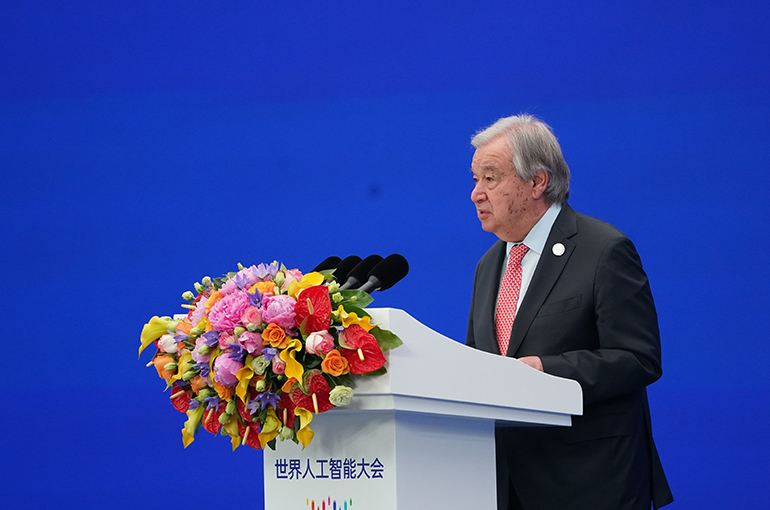
(Yicai) July 20 -- United Nations Secretary-General António Guterres examined China’s latest artificial intelligence technologies and interacted with robots and industry professionals at the recent World Artificial Intelligence Conference in Shanghai, where he also delivered a keynote speech.
During his tour of the expo, Guterres visited the booth of Chinese robotics startup Sharpa, where a humanoid robot was demonstrating how to assemble a paper windmill. According to footage released by China Central Television, after being prompted by staff, Guterres picked up a sheet of paper and flipped it over. The robot detected the change and restored the paper to its correct position and orientation, demonstrating its ability to adapt to unexpected situations.
Guterres also inspected the industrial timing control model developed by Jincheng Technology that was on display at the Shanghai-based company’s stand. The model can be applied in multiple manufacturing scenarios, such as biological fermentation, wastewater treatment and petrochemicals, and can simulate optimal production processes for over 100 hours into the future, helping increase output.
"Guterres showed strong interest in the practical application of the technology during his visit to our booth. He asked about the core value of our technology and he focused on three key areas, namely lower energy consumption, higher efficiency and better economic benefits," founder Li Jinjin, a professor at Shanghai Jiao Tong University, told Yicai.
“AI can be humanity’s greatest opportunity in the 21st century. It could also become one of its greatest risks,” Guterres said at the conference’s opening ceremony on July 17.
"AI can accelerate medical breakthroughs, transform education, strengthen food systems and agricultural productivity, spur new industries and create decent jobs," Guterres said. "However, one-third of humanity is still offline, and many countries continue to face gaps in connectivity, infrastructure, energy access and computing power. Data resources and technical expertise also remain concentrated."
“Technology that will shape the future of humanity must be shaped by all humanity. It cannot be governed by a handful of countries or a handful of companies,” he said, adding that capability, safety and sustainability are the three priorities to help ensure all countries can benefit from the AI revolution.
Guterres also toured MAZU, the AI weather forecasting and early-warning system developed by the China Meteorological Administration. The system is the world's first national action plan developed in response to the UN's Early Warnings for All initiative.
“China has been an important partner. Its platforms, satellites and AI models are already helping dozens of countries strengthen early-warning systems. These tools are built with other developing countries, as partners, drawing on local data, so nations can issue their own warnings. And the tools unveiled here today will widen that reach further,” Guterres said at the WAIC Meteorological Forum.
Editor: Kim Taylor