


 Universities’ AI Detection Thresholds Draw Student Complaints Over False Positives
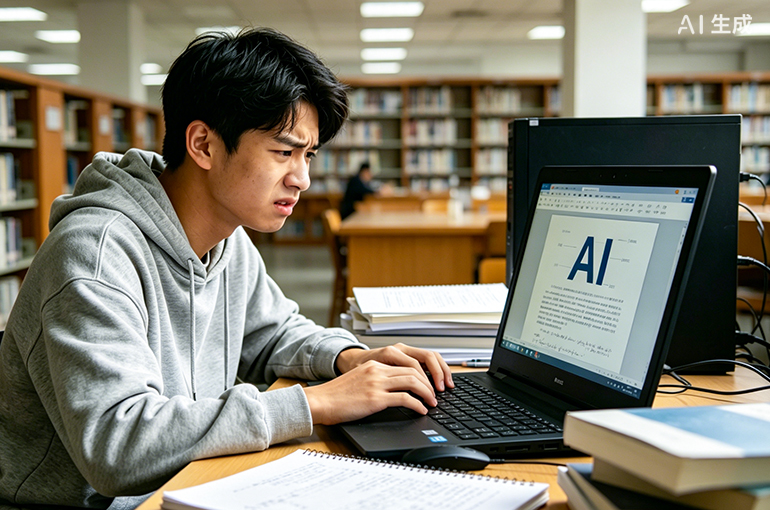
(Yicai) June 4 -- Chinese universities' efforts to curb excessive use of artificial intelligence in graduation theses are backfiring for some students, who say flawed detection tools have forced them into repeated revisions, retests and extra expenses.
Many universities have set AI detection warning lines between 20 percent and 40 percent for undergraduate theses, while postgraduate dissertations often face even stricter limits, according to interviews Yicai conducted with dozens of students from the class of 2026 across arts, humanities and science disciplines.
Students say the standards have become controversial because commercial AI detection tools frequently misidentify original writing as AI-generated content, raising questions about whether detection scores can accurately measure academic integrity or thesis quality.
As AI becomes increasingly embedded in higher education, some academics argue universities should focus less on rigid detection thresholds and more on teaching students how to use AI responsibly and transparently.
False Positives and Rising Costs
Many students interviewed by Yicai complained that commercial AI detection platforms suffer from significant technical shortcomings. Thesis abstracts and English-language translations are particularly prone to being flagged as AI-generated, while even acknowledgements expressing genuine personal sentiments have been mistakenly identified as AI-created content.
A postgraduate student at a leading university in central China told Yicai that detailed descriptions of experiments conducted independently for a thesis were flagged by detection software as exhibiting strong AI characteristics despite being entirely original. The student said repeated revisions and retesting cost a total of CNY780 (USD110) before the paper's AI detection rate fell below the required threshold.
To satisfy detection systems, some students said they removed professional terminology, restructured paragraphs, and altered writing styles. While these changes sometimes lowered AI detection scores, they also made papers less coherent and more difficult to read.
To test students’ complaints, Yicai submitted an integrated circuit industry analysis article written entirely by DeepSeek to several commercial AI detection platforms. One commercial detection provider classified the article, which was 100 percent AI-generated, as having a zero percent AI detection rate.
Experts Call for a Different Approach
Zhao Bin, a professor at the School of Life Sciences of Fudan University, said universities should avoid blindly imposing rigid AI-generated content detection thresholds.
“AI is profoundly reshaping the entire higher education system. Rather than fearing that students will misuse AI to perfunctorily complete academic tasks, universities should teach students to leverage AI tools properly,” Zhao told Yicai.
Instead, Zhao said students should be recognized as the primary parties responsible for their use of AI tools and should be given clear guidance on appropriate boundaries, purposes and standards.
Most students interviewed did not oppose AI detection requirements outright, acknowledging that some peers rely excessively on AI tools. However, they argued that frequent false positives and universities’ continued reliance on AI detection scores as a key assessment metric have left them little choice but to comply.
“The quality of thesis content no longer matters the most; passing plagiarism and AI detection metrics has become the top priority,” a law school graduate at a university in Zhejiang province told Yicai.
The student added that supervisors rarely suggest substantive revisions after reviewing final drafts because even minor changes could cause a thesis to exceed the university’s AI detection threshold.
Universities should focus less on mechanically screening the “robotic tone” of theses and more on the broader goals of education, Zhao added.
Editors: Tang Shihua, Emmi Laine