



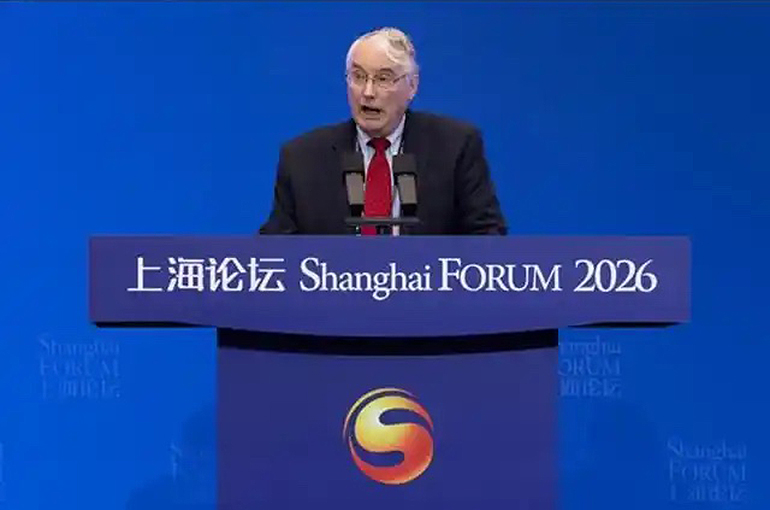
 Trump's Tariff Policy Is a Complete Failure, Former US Assistant Secretary of State Thomas Fingar Says
(Yicai) May 7 -- Former United States Assistant Secretary of State Thomas Fingar defined US President Donald Trump's tariff policy as a "complete failure" during his keynote speech and a group interview with media, including Yicai, at the Shanghai Forum 2026, warning that Washington has become an unpredictable actor on the world stage.
The Trump administration suffers from several shortcomings, including its trade strategy, the erosion of the US credibility, and the growing constraints the White House faces, such as the Supreme Court and the upcoming midterm elections, according to Fingar, who is now a fellow at Stanford University's Freeman Spogli Institute for International Studies.
Fingar admitted to Yicai that he cannot determine the true intention of the Trump administration in introducing the tariff policy. "Unless his goal is to disrupt the global international trade order, the policy is a complete failure in terms of its effects," Fingar noted. "The original intention of the Trump administration in introducing the tariff policy was to reduce the US trade deficit, boost domestic manufacturing investment, and build a fair international trade environment for US enterprises, but none of these goals have been achieved."
In terms of actual effects, the tariff policy has not only failed to reduce the US trade deficit but also pushed up the prices of imported goods and increased US enterprises' production costs and US consumers' living costs, exerting a negative impact on the domestic economy.
"At the same time, the tariff policy has not driven the growth of domestic manufacturing investment in the US, because corporate investment decisions depend on various factors such as market demand and the business environment,” Fingar said. "Simple tariff protection cannot fundamentally solve the difficulties faced by the US manufacturing industry.
"Moreover, these tariff policies have not achieved the goal of fair trade," he added. "Instead, they have triggered global trade frictions and damaged trade relations between the US and its allies."
On Feb. 20, the US Supreme Court ruled by a six-to-three vote that the Trump administration's large-scale tariff hikes based on the International Emergency Economic Powers Act were unconstitutional. Tax refund arrangements were also put on the agenda.
On April 20, the US Customs and Border Protection launched the Consolidated Administration and Processing of Entries system to process refund applications, with payments expected to be issued within 60 to 90 days. The scale of illegal tariffs to be refunded is about USD166 billion to USD176 billion.
Even though the US Supreme Court has ruled that most of the tariff measures introduced by the Trump administration are illegal, it has not yet given up and plans to re-implement these tariff policies by changing the legal basis.
"However, the current international situation has also restricted the promotion of the tariff policy," Fingar pointed out. "The ongoing Middle East conflict has pushed up the prices of global commodities, such as oil, gas, and chemical fertilizers, exacerbating inflationary pressures in the US.
"Under such circumstances, more and more people within the Trump cabinet have begun to oppose tariff increases, believing that this will further push up inflation and damage the US economy and the interests of the people," he added. "Therefore, there is great uncertainty about whether the Trump administration will continue to implement the tariff policy in the future."
Phillip Swagel, Director of the US Congressional Budget Office, warned on April 27 that a series of recent changes in tariff policies may push up the federal budget deficit by a total of about USD1.1 trillion over the next decade. But due to the unclear policy direction, accurate calculation cannot be completed yet.
Reshaping the Global Governance Structure
Unilateralism continues to impact the existing international trade system, and the global order has fallen into a turbulent predicament of being subverted. Therefore, there is a need for a reshaping of the global governance structure.
Building a new global order is not a simple, rapid, and spontaneous process, Fingar said in his keynote speech. It requires concerted efforts from all countries around the world, as well as in-depth cooperation and consultation.
The dimension of global governance reform can never be unilaterally dominated by a single country or a few countries, let alone be arbitrarily ruled and forcibly implemented by them, he added. This approach is unworkable and can never be truly put into practice.
Regarding the Trump administration's military operations and repeated statements in Latin America and the Middle East since the start of the year, Fingar noted in the group interview that Trump's series of actions is "pushing the US soft power off a cliff," and it will be very difficult and require a great deal of time and energy for the country to climb back up.
"The US used to be a firm and predictable participant on the world stage, but now this predictability has completely disappeared," he pointed out. "This policy unpredictability is prompting countries around the world, including America's closest allies, to find ways to bypass the US to reduce the risk of their own losses."
Domestic Agenda Takes Priority
Fingar's personal career is closely linked to the course of China-US relations. Whenever major events occur between the two countries, he is always present. Although he has withdrawn from politics, he still pays close attention to China-US relations.
2026 is a big year for China-US relations, as a series of high-level interactions will be held between the two sides, Xie Feng, Chinese Ambassador to the US, stated at the opening ceremony of the World Trade Centers Association Global Business Forum on April 20, according to the website of the Chinese Ministry of Foreign Affairs.
China will host the Asia-Pacific Economic Cooperation Economic Leaders' Meeting, and the US will host the G20 Leaders' Summit this year. Head-of-state diplomacy is the "compass" and "ballast stone" of China-US relations, according to Xie.
The key to understanding Trump's foreign policy is to recognize that he has listed domestic governance reform as his core priority, which is also an important public opinion foundation for his election as US president, Fingar believes.
About the current China-US bilateral relations, Fingar said cooperation bonds still exist. For example, economic and trade cooperation, people-to-people and cultural exchanges, academic exchanges, and industry collaboration in professional fields are all important pillars of China-US relations.
"However, compared with before 2008 and 2009, the number of these cooperation pillars has decreased, and their intensity has weakened," Fingar pointed out. "Among them, the most obvious change is the significant decline in the willingness of the US business community to cooperate with China, which is also the biggest shortcoming facing current China-US relations."
Yicai asked Fingar about whether the willingness of the US business community to cooperate with China will recover in the future. He responded that it depends not only on China but also on the upcoming US midterm elections, which will further restrict Trump's foreign policy and indirectly affect the US business community's China strategy.
"The US government is focusing on supporting core industries, such as high technology, electronics, and oil and natural gas, which have gained enormous development advantages through policy dividends and formed powerful interest groups," Fingar noted. "The core demand of these interest groups at present is to maintain US policy dividends, so they will not take the initiative to promote the US government to adjust relevant policies in the short term.
"More importantly, the competition among global export-oriented emerging economies is constantly intensifying," he added. "As latecomer export-oriented countries -- India, Indonesia, Turkey, Colombia, and others -- have successively joined the global trade system, and they continue to divert US foreign investment by virtue of their own advantages."
In Fingar's opinion, compared with previous administrations, the core logic of US policy toward China under Trump is highly consistent and has no essential difference. For example, the Biden administration's China strategy can be summarized as "avoiding deterioration and maintaining the status quo." In contrast, the Trump administration's China strategy has varied in different terms.
During his first term, Trump adopted a relatively aggressive China policy, actively escalating China-US contradictions by imposing tariffs and suppressing Chinese technology companies, attempting to force China to make concessions through tough means, Fingar explained. "But in this term, Trump's China strategy has become relatively restrained, essentially because his core energy is focused on domestic affairs and he is unwilling to add the burden of diplomatic governance."
The Biden and the Trump administrations share a common core in their China policies, which is prioritizing the domestic agenda, Fingar believes. "The consensus in Washington is that rather than expending political capital to promote external bilateral cooperation, it is better to focus on domestic affairs."
Midterm Elections Have a Greater Impact on US Domestic Affairs Than Foreign Affairs
The US midterm elections are about half a year away. In late April, multiple authoritative polls showed that Trump's approval rating is at 33 percent to 36 percent, its lowest level since his second term, while his disapproval rating has risen to a record high of 58 percent to 63 percent.
"Analysts who pay more attention to US domestic politics than I do generally believe that it is realistic for the Democratic Party to regain control of both the Senate and the House of Representatives," Fingar said about the midterm elections.
"Among them, flipping seats in the House of Representatives is relatively easy, as the Democratic Party only needs to win a few seats to take control of the House," he explained. "However, the competition in the Senate is more intense, and it will be more difficult for the Democratic Party to take control of it."
In Fingar's view, if the Democratic Party can take control of both houses of Congress, Trump will enter a "lame-duck" governing state in advance, which means that most of his policy agenda will be restricted and vetoed by Congress. In terms of foreign policy, the Congress will most likely block the Trump administration from increasing tariffs, implementing radical foreign military operations, and other foreign policies inconsistent with the Democratic Party's stance.
Moreover, the Congress will also be able to strengthen supervision over the Trump administration and restrict the abuse of its executive power, Fingar added.
"But it should be noted that even if the Democratic Party takes control of Congress, it will be difficult to take the initiative to promote a new foreign strategy," Fingar believes. "Because the US foreign policy guidelines are mainly led by the White House, and although the Congress has supervision and veto power, it cannot directly formulate and implement foreign policies.
"Therefore, after the Democratic Party takes control of Congress, it will be more about 'restriction and checks and balances' rather than 'policy shift,'" he noted. "It can block the Trump administration's radical policies, but cannot completely change the direction of US foreign policy."
The outcome of the midterm elections will have a far greater impact on US domestic policies than on foreign policies, according to Fingar.
"If the Democratic Party takes control of Congress, there will be more policy adjustments in areas such as local governance, people's livelihood policies, medical security, and education financing," Fingar said. "These adjustments will directly affect the lives of US citizens and also change the domestic political pattern of the US.
"However, the room for adjustment in foreign policy is relatively limited," he added. "After all, the White House still holds the decision-making power in foreign affairs."
Editor: Futura Costaglione