



 Robot Vacuums' Inflection Point Will Likely Arrive by 2029, CEO of China's Narwal Says
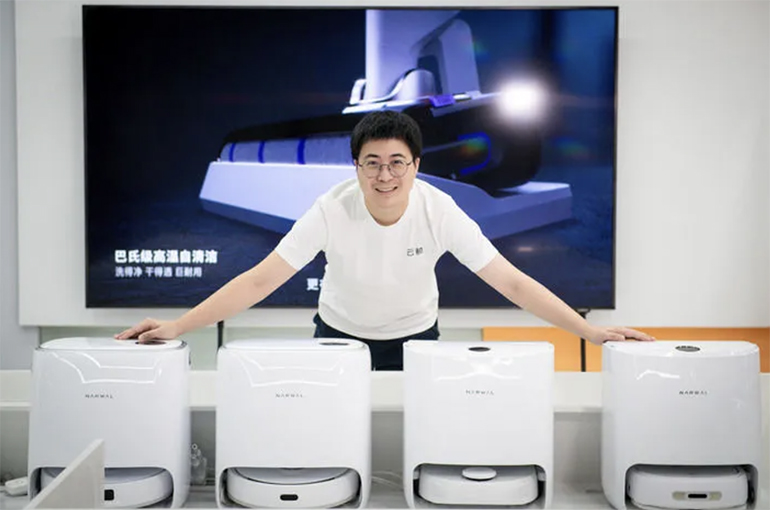
(Yicai) May 29 -- The robot vacuum cleaners sector is expected to reach an inflection point within three years, driven by improvements in quality, cost, and user experience, according to the founder and chief executive of leading Chinese smart cleaning robots maker Narwal Robotics.
A separate cost-reduction inflection point tied to economies of scale will not arrive until China's annual output exceeds 50 million units, Zhang Junbin told media, including Yicai, last week. The penetration rate of robot vacuums in China was around 6 percent last year and is tracking at about 7 percent this year, while reaching 20 percent in some overseas markets, but remaining below 10 percent in most, he pointed out.
"Some companies keep piling on components and features while quality is declining, eroding consumer trust," Zhang said regarding the lack of penetration growth. Obstacle-avoidance systems that frequently jam are one example, with the industry needing time to work through features that are not fully refined yet, he pointed out.
The number of robot vacuums sold online in China dropped 20 percent to 940,000 units last quarter from a year ago, while sales fell 10 percent to CNY3.1 billion (USD430 million), according to data from market research firm Runto Technology.
Leading domestic manufacturers are also seeing varying performance, with the net profit of Roborock Technology tumbling 31 percent last year from the previous year before returning to a year-over-year growth in the first quarter, while Ecovacs saw its annual profit surge 118 percent but reported a 15 percent drop last quarter.
Global robot vacuum shipments jumped 17 percent to 24.12 million units last year from 2024, according to figures from International Data Corporation.
With penetration growth slowing and competition intensifying, robot vacuum manufacturers face a dilemma of cutting prices and sacrificing margins to reach a broader customer base, or holding to a premium positioning strategy.
Narwal has leaned toward the premium end, Zhang said, noting that mid-to-high-end products account for nearly 90 percent of its portfolio, but penetration of lower-tier markets will be a major growth driver for cleaning appliances over the next two to three years. The company has also decided to accelerate its expansion amid intensifying competition and realizing that different price tiers require diverse products, he added.
Roborock, Ecovacs, Dreame Technology, and Mova each launched five or more new robot vacuum models in the first quarter, while Narwal released just two models, one each in the high and mid price tiers, while also entering new cleaning categories, including anti-mite vacuums.
Last September, with Narwal expanding its product range, Zhang took charge of the marketing division and restructured its channels, pricing system, and partner network, lifting the firm's gross margin by more than 10 percentage points. Profit remains the priority, he said, with a broader expansion push expected to begin next quarter once remaining gaps are addressed.
In addition, embodied intelligence is starting to reshape the industry. Narwal bagged USD100 million in a pre-initial public offering fundraiser last year, with part of the funds to be used for embodied intelligence development.
Narwal robots' embodied intelligence capabilities include toilet cleaning, vertical tile cleaning, and limited object-grasping tasks, Zhang said, but added that bringing such products into households will take time, which he sees as the company's defining bottleneck over the next decade.
Editor: Martin Kadiev