


 China’s JD.Com Enters European Market, Betting on Fast Delivery to Attract Shoppers
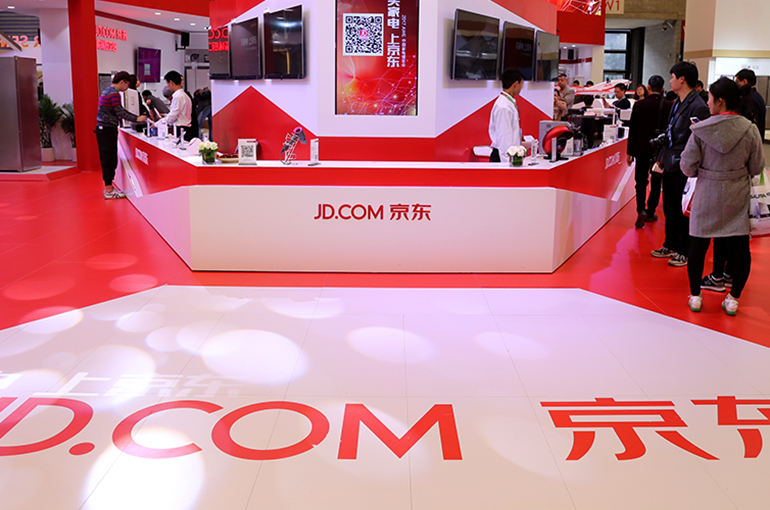
(Yicai) March 16 -- JD.Com has officially launched its Joybuy e-commerce website in Europe, aiming to entice consumers with next-day deliveries provided by the Chinese online retailer’s own logistics service.
Joybuy is now available in six European countries -- Belgium, France, Germany, Luxembourg, the Netherlands, and the United Kingdom -- after nearly a year of testing. It offers fast delivery through JD.Com’s logistics service JoyExpress, which launched in Europe last month, and lower free shipping thresholds than competitors such as Amazon.
The European market has huge growth potential, Zhang Zhouping, executive director of Bense Think Tank and deputy director of the Zhejiang Cross-Border E-Commerce Industry Alliance’s research institute, told Yicai. JD.Com can undercut rivals by replicating its mature ‘self-operated + logistics’ model and same-day delivery in Europe, he added.
During a recent blizzard, highways were closed, and all courier services were suspended, but Joybuy still delivered as usual, according to a German blogger. Another blogger in Europe noted that when local transportation ground to a halt because of strikes, Joybuy was unaffected.
Joybuy’s delivery efficiency surpasses other logistics firms such as DHL, with near same-day delivery for most goods and next-day delivery for fresh foods, a German user told Yicai. It not only delivers faster than Amazon but also has lower free shipping thresholds and simpler, more convenient return policies, according to another user in Germany.
In Germany, Joybuy’s free-shipping threshold is EUR29.90 (USD33), compared with Amazon’s EUR49. “Amazon previously accounted for 90 percent of my online shopping, but now, Joybuy takes 80 percent, and Amazon only 10 percent,” one of the German users said.
Asset-Heavy Logistics Model
JD.Com is replicating JD Logistics’ heavy-asset model, which has proven successful in China, across Europe. So far, it operates more than 60 logistics warehouses and courier depots on the continent, providing integrated supply chain, logistics, and delivery services for Joybuy buyers.
JD Logistics opened its first overseas intelligence warehouse in the UK last December. Covering more than 3,000 square meters, it is equipped with nearly 200 self-developed logistics robots. With the help of these and a smart system, each human worker can easily pick out more than 300 items per hour, roughly quadrupling picking and outbound efficiency.
JD Logistics also closely monitors local social media platforms and strives to improve services based on user feedback to enhance the customer experience. On platforms such as TikTok, overseas shoppers often post Joybuy unboxing videos. One UK blogger’s clip showing a self-heating hotpot bought on Joybuy drew 210,000 likes and more than 10,000 saves.
To accelerate its expansion in Europe, JD.Com has been acquiring local retail assets. For example, the company announced last July that it would buy Germany’s Ceconomy, the parent firm of consumer electronics retailers MediaMarkt and Saturn, for EUR2.2 billion (USD2.4 billion). The two operate about 1,000 stores in 11 European countries.
But heavy-asset business models face high costs and relatively large inventory risks, Zhang Yi, chief executive of market research firm iiMedia Research, told Yicai. Moreover, compliance costs for labor, warehousing, and delivery in Europe are much higher than in China, so Joybuy is expected to remain in the red for an extended time, he noted.
The European market is more fragmented than China’s. Improving warehouse and distribution network use, bringing unit costs under the heavy-asset model down to a reasonable level, and managing a longer return-on-investment cycle than in China are issues that JD Logistics must solve, Zhang pointed out.
As a new player, Joybuy also faces local competitive barriers, complex regulatory and legal systems, and challenges from trade unions, Zhang added.
Editors: Tang Shihua, Futura Costaglione