



 Fed Chair Powell Staying as Governor Stirs US Central Bank's Power Game
(Yicai) May 8 -- The central banks in the United States, Europe, the United Kingdom, and Japan all decided to keep interest rates unchanged at their monetary policy meetings last week, in line with market expectations.
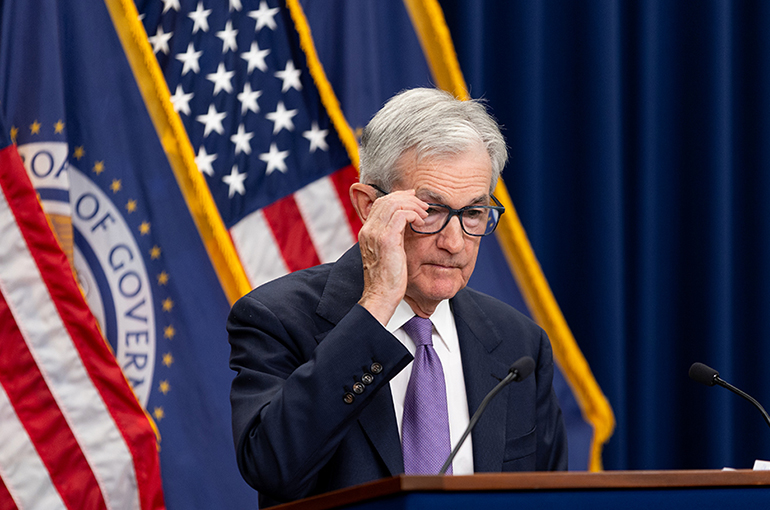
At his last press conference as the chairman of the US Federal Reserve, Jerome Powell said that due to the unprecedented legal actions taken by the White House against the Fed, he will not retire and continue to serve as a governor, as the Fed needs to be able to implement monetary policies without being influenced by politics.
US Treasury Secretary Scott Bessent said that Powell's decision violates the Fed's usual practice and is an insult to the new chair, Kevin Warsh. Powell's decision means that Stephen Miran, the White House's agent in the Fed, must resign and vacate the position of a governor for Warsh -- assuming that governor Lisa Cook, who is appealing to the Supreme Court, does not voluntarily resign. This move may affect the Fed's future decisions as the majority of the members of the Board of Governors hold a moderate-to-hawkish stance similar to Powell's.
Under Powell's leadership, the Fed has gone through a series of major events, such as the Covid-19 pandemic, supply chain crises, soaring wages, and the tariff war, and initiated policies including quantitative easing in 2020, rapid interest rate hikes in 2022, and balance sheet reduction in 2024.
Last year, Powell halted interest rate cuts and had a significant disagreement with the White House. He was repeatedly called 'Mr. Too Late' by US President Donald Trump. In recent months, the Trump administration even filed a lawsuit against Powell on the grounds that the renovation of the building exceeded the budget.
Warsh emphasized at the hearing of the Senate banking committee that there was no tacit agreement between him and Trump to lower interest rates, but the market generally believes that he intends to do so. The situation about the war in Iran is unclear, but inflation and consumer expectations have already taken shape, and it is quite difficult to cut interest rates now, unless the job market collapses.
Powell staying as a Fed governor is bound to become the flag-bearer of the moderate faction in the central bank, creating barriers for a short-term rate cut and presenting uncertainties for the market.
The most controversial point about Warsh is his intention to restructure the Fed from its strategy to its organizational structure. Over the past three decades, the role of the Fed has been continuously expanded from price stability and employment to supervising banks, stabilizing market sentiment, providing forward guidance, and even assisting the government in issuing bonds.
Warsh believes that the Fed is overly involved and advocates that it should have an independent monetary policy and a flexible balance sheet. His underlying economic logic is the new supply-side economics, which is a rebellion against the traditional thinking mode of the Fed based on Keynesianism.
UAE's Withdrawal From OPEC Has Eroded Its Pricing Power
Last week, the United Arab Emirates announced they will withdraw from the Organization of the Petroleum Exporting Countries and OPEC+, resulting in significant changes to the oil market and the geopolitical landscape.
As the third-largest oil producer in OPEC, the UAE's withdrawal indicates a major crack in cohesion within the organization and shows that Saudi Arabia's leadership position in OPEC has been challenged, which will likely result in the departure of other member countries that wish to increase production.
Once OPEC's model of oil price manipulation through controlling production fails, the global energy pricing power may accelerate its shift towards the US.
The original goal of OPEC was for oil-producing countries to unite and fight against the pricing power of Western oil companies. In the 1970s, the oil embargo caused the oil price to quadruple. However, as the production capacity of non-member countries expanded, OPEC's market share continuously declined, and it was a common occurrence that member countries secretly increased production.
In the past decade, Abu Dhabi National Oil has invested heavily, and the production capacity of the UAE has jumped 50 percent, but the quota it received from OPEC was far lower than its actual production capacity. Saudi Arabia insisted on reducing production to stabilize oil prices, while the UAE wanted to convert new production capacity into actual exports. Eventually, they parted ways.
OPEC still accounts for 40 percent of the world's oil production, but its pricing power has been severely eroded. The shale oil revolution has enabled the US to surpass Saudi Arabia and become the world's largest oil producer with a daily output of over 13 million barrels. The departure of the UAE has not only deprived OPEC of 3.4 million barrels per day of production but also of important idle capacity, which is the key leverage for OPEC to stabilize oil price fluctuations.
The structural weakening of OPEC will make it even more difficult for it to coordinate supply and stabilize prices.
The petrodollar system may weaken, but it will not collapse. The status of the US dollar is not solely supported by oil trade but also a large and highly liquid US financial market, including the US dollar settlement inertia, which accounts for nearly 90 percent of global foreign exchange transactions, and the over USD6 trillion foreign exchange reserves held by central banks of various countries.
The switch of the settlement currency in oil trade is only the most superficial aspect of the de-dollarization. What truly determines the status of a reserve currency is the depth of the financial market, the stability of the system, and the free flow of capital.
The author of this article is Tao Dong, president and chief economist at Springs Capital Hong Kong. This article expresses only Tao's personal opinion and does not represent the official stance or predictions of the company where he works. This is not an investment recommendation or solicitation.
Editor: Futura Costaglione