



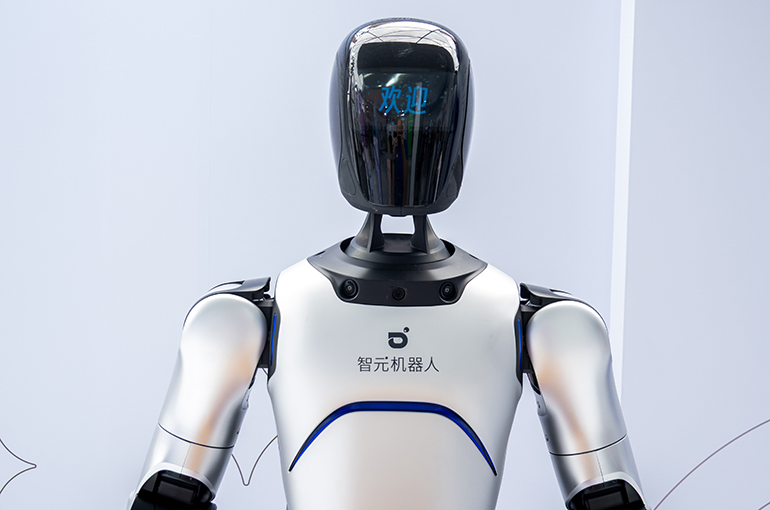
 AgiBot Has Started Using Chinese Chips in Its Robots, Senior VP Says
(Yicai) July 22 -- AgiBot, a Chinese startup developing embodied intelligence and humanoid robots, has begun working with domestic chipmakers, a senior vice president said, as the robotics sector is entering the pivotal mass production stage, creating new opportunities for China-made chips.
AgiBot is in initial partnership talks with multiple chipmakers, Wang Chuang told Yicai during the World Artificial Intelligence Conference in Shanghai, without naming any. The Shanghai-based firm is already using some domestic chips for robot cerebellums -- microcontroller units that manage joint actions -- as well as other communication chips, he said.
China's humanoid robot leaders are increasingly moving toward using domestically developed semiconductors, not only for low-level control functions such as motor control, communications, and dexterous hands, but also for higher-performance embodied artificial intelligence. The shift is being driven by a combination of cost, supply chain localization, and the rapid scaling of the country's humanoid robotics industry.
Agilink, a subsidiary of AgiBot that is developing dexterous hands for humanoid robots, picked Chinese MCUs after considering performance and price, Chief Technology Officer Xiong Kun said.
Agilink is using general-purpose MCUs, while also developing some customized chips, Xiong told Yicai. These small devices, which are installed in the palm of a dexterous hand, are responsible for motion computation as well as sensor data processing, he added.
The next-generation A3 robot developed by Chinese startup TARS will also use domestic chips, co-founder Chen Tongqing told Yicai. “Our main requirements for partners are, first, a more powerful edge-computing platform, and second, a team with engineering experience that can work closely with us on system integration and joint debugging,” Chen said.
TARS, which has dual headquarters in Beijing and Shanghai, raised USD455 million and USD242 million from fundraisers this April and in the second quarter of last year.
The A3 is a wheeled dual-arm robot designed for the mass production of products such as automobiles. It will use an edge chip that can complete 560 trillion basic operations per second, balancing the computational demands of large model inference with the real-time control requirements of robots.
China's Ubtech Robotics, the world's first humanoid robot maker to go public, has set up a joint venture with domestic chipmaker MetaX to focus on the research, development, and mass production of smart chips for embodied robots. MetaX sees major opportunities arising from the rapid growth of the embodied intelligence industry, Senior VP Sun Guoliang told Yicai.
“MetaX has chosen not to develop its own chips for embodied intelligence robots because on-device application scenarios are highly diverse and product formats vary significantly,” he said. “Developing such chips alone would require substantial additional manpower. That is why we chose to jointly develop them with Ubtech.”
Chinese robotics startups once defaulted to Nvidia chips, but mounting cost pressures are increasingly pushing them toward domestically developed alternatives.
"Many foreign chips are too expensive," said Zhou Jian, chairman of Shenzhen-based Ubtech. “They account for a third of the bill of materials cost of hardware component procurement.”
Editors: Tang Shihua, Martin Kadiev