



 Chinese Robotic Firms Entice Fresh Graduates With Annual Salary of Almost USD150,000
(Yicai) Oct. 19 -- Several job-seeking students said outstanding fresh graduates have received offers with annual pay of as much as CNY1 million (USD149,450) from Chinese robotics companies during the fall campus hiring season. However, the recruitment bar has risen amid increasingly fierce competition, as higher wages lure more talent.
Some companies have offered "million-yuan annual salaries" to recruit outstanding fresh graduate students this year, several students told Yicai. The background of such talent typically includes C9 League universities (an alliance of nine prestigious public Chinese colleges: Fudan University, Shanghai Jiao Tong University, Harbin Institute of Technology, Nanjing University, Peking University, Tsinghua University, University of Science and Technology of China, Xi'an Jiao Tong University, and Zhejiang University), two to three internship stints at well-known firms, and high-quality published papers, they pointed out.
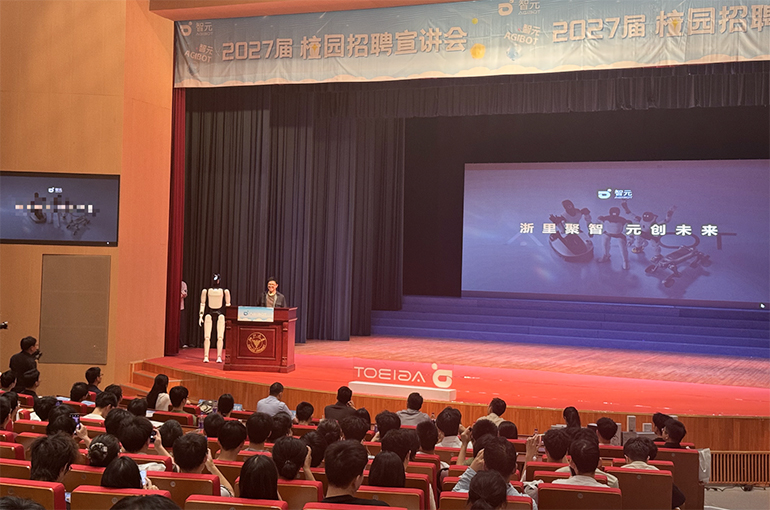
Over the past two years, salaries in China's robotics sector have surged amid an expanding humanoid robot market and a shortage of high-end talent. Unitree Robotics, AgiBot, and Galbot launched their fall campus hiring programs in mid-August, with Alibaba Group Holding, Tencent Holdings, and JD.Com also vying for talent. The embodied intelligence boom has further boosted demand for related positions.
For model training and core algorithm roles, annual packages vary by company but generally fall into several tiers: the relatively low at around CNY400,000 (USD59,780), the common at about CNY500,000, known in the industry as the "cabbage price," and the range most job seekers aim for at CNY600,000 to CNY800,000.
However, multiple students learned in closed-door sessions that companies offer few slots during fall campus hiring, with some startups valued at over CNY20 billion (USD3 billion) needing just 20 to 30 people, while a headcount of 100 employees is rare in the industry. However, presentations held by many leading startups are almost always packed.
The scarcity of positions and the growing number of applicants have also raised companies' hiring bars, students noted, adding that artificial intelligence model-related roles at leading embodied intelligence companies mostly require a master's degree, with Double First-Class or even C9 League colleges as the basic requirement, while hardware-related jobs are slightly more relaxed and include bachelor's degree holders. However, applicants' internship experience and its relevance to the post are seen as a more important door-opener, with high-caliber papers being a plus, they pointed out.
The campus recruitment head at an embodied intelligence firm said it does not use academic credentials as the sole screening criterion. For algorithms and robotics roles, it focuses on candidates' technical foundations and how relevant their research, projects, or internship experience is to the role, the person noted.
Li Feng studies automation at a 985 university (a group of 39 elite public universities in China selected for Project 985, which aims to build world-class research institutions) in an eastern province, focusing his research on drones. Set to graduate with a master's degree next June, Li said AI algorithms and reinforcement learning from the drone field can transfer to embodied intelligence, so he is more eager to enter that sector given the limited job opportunities in the drone market.
Li has applied for more than 100 jobs over the past two months, failing the resume screening stage at 20 companies, while 10 advanced him to interviews. He believes he lacks sufficient internship experience, having interned at an embodied intelligence startup in Shanghai for only four to five months.
Xiao Jimao, who graduated from a 985 university and is in his third year of graduate studies at Peking University, meets the academic thresholds of multiple major tech companies and leading startups, but he also lacks sufficient internship and research experience, so some of his resumes did not pass screening. "The relevant departments require candidates to have at least one or two good papers, and to be the first author," he pointed out.
As of Oct. 10, Xiao had received offers from five firms, including one from campus hiring and four return offers from internships. From the perspective of a job-seeking student, he believes the fall recruitment has become a "big gamble," and if they fail to secure an offer after the probation period, they will be thrown back into the job market.
"So many candidates are flooding in, with companies wanting them to start work as soon as possible," according to an industry insider who takes part in candidate interviews, noting that this is a major reason for the increase in internship-to-employment return offers. The embodied intelligence recruitment market has a structural imbalance: high-end talent is scarce, while lower-requirement positions are relatively saturated, the person stressed.
In addition, the technical roadmap in the embodied intelligence industry has yet to converge, while the commercialization prospects of many companies remain unclear, making students particularly cautious.
"The industry has a low tolerance for error. Some startups bet on a particular technical route, with the company likely to collapse if the route is proven wrong in the future," said Yu Qing, who saw firsthand the restructuring at a major firm's embodied intelligence unit during an internship. When screening jobs, Yu pays close attention to the firm's technical roadmap and the strength and background of its founders, he pointed out.
Several interviewed job-seeking students share a view that the embodied intelligence boom may be short-lived, expecting the industry's financing pace to slow down in the second half of this year. The next two years may be a good window to enter the sector, they noted.
Editor: Martin Kadiev