



 China’s Unitree Loses Nearly USD15 Billion in Market Cap in First Four Trading Days
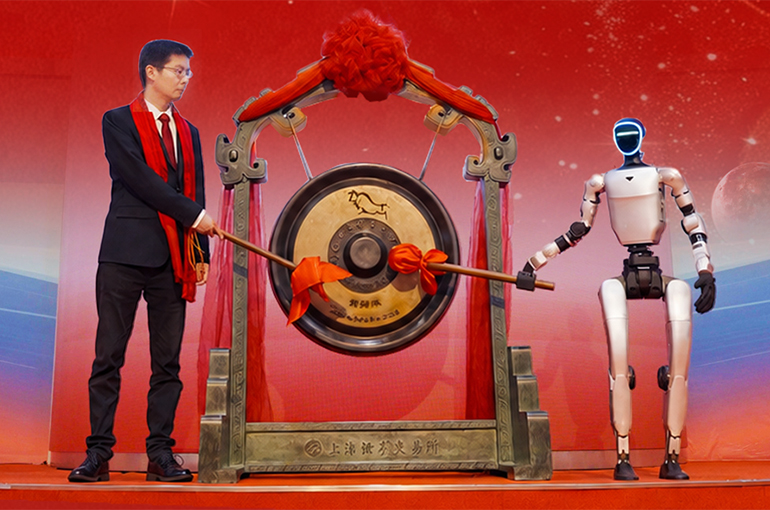
(Yicai) Aug. 24 -- Unitree Technology has seen nearly CNY100 billion (USD14.8 billion) wiped from its market capitalization in the four trading days since the Chinese humanoid robot maker debuted on the Star Market, Shanghai’s answer to the Nasdaq.
Unitree’s share price [SHA:688836] closed down 10.3 percent at CNY603.08 (USD90) today. The Hangzhou-based company’s market cap has shrunk by more than 28 percent to CNY243.9 billion (USD36.2 billion) from CNY341.7 billion at the close of its first day of trading on Aug. 19.
The embodied-intelligence sector is in a bubble, with companies yet to establish a genuinely sustainable commercial model, an investor familiar with the sector told Yicai. Beyond use in scientific research and performances, Unitree’s robots have yet to prove their commercial viability in other scenarios, such as working in factories, the person said.
“Unitree’s stock price pullback is partly due to tighter market liquidity amid a wave of large initial public offerings along with increasing pressure from sector rotation,” said Shen Meng, executive director at Chanson & Co., a Beijing-based investment bank. Unitree’s biggest challenge will be demonstrating that humanoid robots can be used in manufacturing and services, delivering measurable gains in productivity and efficiency, he added.
Unitree said it expects net profit, excluding non-recurring items, to have slumped by as much as 22 percent in the first half from a year earlier to CNY283 million (USD42 million), while revenue may have jumped by up to 45 percent to CNY1.1 billion (USD163.6 million).
Unitree’s robots failed to win any medals at the second World Humanoid Robot Games staged in China’s capital yesterday, despite a strong performance in track-and-field events last year.
The firm’s two-meter high-jump record, disclosed the day before its listing, was beaten by the Tiangong Ultra robot, developed by the Beijing Humanoid Robot Innovation Center in collaboration with UBTech Robotics, which cleared 2.88 meters. Unitree also finished well behind Tiangong androids and robots developed by Honor in the 100-meter robot sprint.
At the 2026 World Robot Conference held in Beijing on Aug. 20, Unitree’s founder Wang Xingxing outlined the firm’s efforts to move beyond demonstrations and put robots to use in the real world. He said Unitree has spent the past several years working to bring robots into everyday life and factories to carry out actual tasks.
In 2024, Unitree linked arms with automakers to deploy robots in vehicle plants and also began testing robots at its own manufacturing facilities. Wang said the biggest obstacles to large-scale deployment remain efficiency and limited generalization capabilities.
Unitree is also exploring ways to enable physical-AI models to “self-evolve.” After establishing a set of rules, engineers use large AI models to search for academic papers, research findings, and open-source solutions to automatically generate robot-control codes. These are then tested in simulated and real-machine environments. Feedback from robots and humans is then fed to the AI agent, creating a continuous loop. Wang said this approach can enable robots to build skills and data continuously, thereby improving the efficiency of robot development and evolution.
During the World Robot Conference, Unitree unveiled a new bionic seven-axis dexterous robotic arm, priced from CNY9,900 (USD1,472). Weighing just 5.5 kilograms, it is intended for use in a range of research and educational scenarios. Two arms can work together to perform tasks such as material sorting and assembly, while also opening up potential uses in service robotics.
Editor: Kim Taylor