



 Chinese Rehab Robot Makers Leverage Tech Advantages to Expand Overseas, Experts Say
(Yicai) May 15 -- Chinese manufacturers of rehabilitation robots are accelerating their push into overseas markets on the back of technological advantages, though regulatory barriers and market awareness remain key challenges, according to experts.
Chinese tech companies are developing fast, with robot tech rapidly iterating, José Luis Pons, scientific chair of the Legs + Walking Lab at Shirley Ryan AbilityLab, said at the Global Rehabilitation & Assistive Technology Network Summit, which drew around 70 overseas partners in Shanghai from May 13 through today.
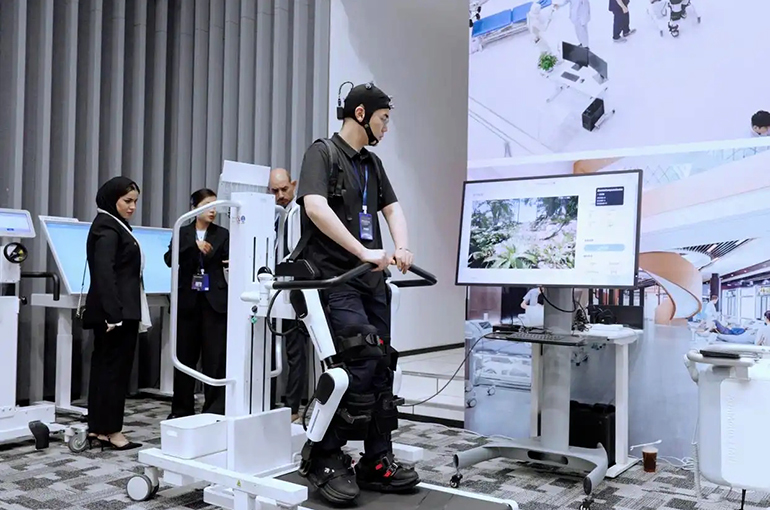
Artificial intelligence and brain-computer interface tech took center stage at the GReAT Summit, with the clinical application of electroencephalography-driven lower-limb exoskeleton robots shown live. Shirley Ryan AbilityLab has allied with Chinese robotics firm Fourier, whose rehab tech arm hosts the event, for nearly seven years.
BCI-related applications are already being piloted at Chinese hospitals and will be tested abroad this year, said Owen Teoh, managing director of Fourier Intelligence. A deal with Singapore's National Healthcare Group includes the application of BCI, he said, adding that the company's overseas sales doubled last year.
Other Chinese companies, including elderly-care exoskeleton supplier RoboCT Technology Development and rehab robot maker Zepu Medical Technology, have also entered overseas markets, shifting from exporting individual products to exporting technical application solutions and industrial systems. For example, BangBang Robotics has expanded from simply selling to after-sales service channels abroad.
Regulatory Access Remains a Shared Pain Point
Rehab robots are classified as medical devices in most countries and must meet safety and ethical requirements that vary significantly by jurisdiction.
Approval processes in Europe are time-consuming, noted Robert Riener, head of the Sensory-Motor Systems Lab at ETH Zurich. The pace of hardware and software iteration has outrun regulatory frameworks, creating a mismatch that constrains commercialization, he stressed.
Market receptiveness also varies, with rehab robots already widely used in the United States and so requiring less time for extensive market education, while the European market tends to be more conservative, Teoh pointed out.
For markets with lower acceptance, companies are pursuing a "partnership-first, market-second" approach, entering through clinical-stage collaborations with local universities or research institutions, Teoh said. Such tie-ups do generate some sales, but more value lies in understanding market needs to refine products and accumulate experience for localization, he noted.
The global rehabilitation equipment market reached USD23 billion last year and will likely top USD47.2 billion by 2035, according to Global Market Insights. Growth will be led by the Asia-Pacific region, with key drivers including an aging population, rising rates of musculoskeletal disorders, and higher chronic disease prevalence.
Robotic rehab tech is currently used primarily in stroke treatment and neurological recovery.
Editor: Martin Kadiev