


 China’s Auto Industry Backs China-EU Trade Deal on Hybrid Cars
(Yicai) Oct. 15 -- China’s automotive industry has welcomed the trade understanding reached by the world’s biggest car-producing nation and the European Union on hybrid electric vehicles.
“By relying on the World Trade Organization platform and insisting on handling trade frictions through dialogue and consultation, China and the EU have set an example for the international community in properly resolving differences,” the China Association of Automobile Manufacturers said after the bilateral trade arrangement was announced early this week.
A number of individual Chinese automakers joined the CAAM yesterday in welcoming the new trade understanding. BYD, China’s biggest automaker, said that after more than 30 rounds of consultations held by China and the EU, the outcome “effectively manages trade differences and prevents frictions from escalating, having created a stable, predictable, and sustainable cooperative environment” for the trade in hybrid vehicles.
Geely Holding Group said it supports the three fundamental principles affirmed by both sides, which are respect for facts, non-discrimination, and compliance with WTO rules, adding that the outcome “bolsters the confidence of enterprises in taking part in China-EU economic and trade cooperation.”
“Open cooperation and win-win outcomes are the shared direction of the global automotive industry’s development,” Chery Automobile said. The carmaker welcomes and supports the two sides in properly handling differences through dialogue and consultation, it added.
GAC Group stated that it would continue to operate in a lawful and compliant manner, using the new consensus as an opportunity to further cultivate the European market and deepen cooperation with European partners.
Fundamental Principles
A Chinese commerce ministry spokesperson said on Oct. 12 that the deal effectively safeguards the interests of Chinese businesses, prevents China-EU trade frictions from escalating, and provides a stable, predictable, and sustainable environment for bilateral trade and investment, thereby contributing to the stable, balanced, and sound development of China-EU economic and trade relations.
The person noted that the two sides had agreed on three fundamental principles governing the trade in hybrids: respect for facts, non-discrimination, and compliance with WTO rules.
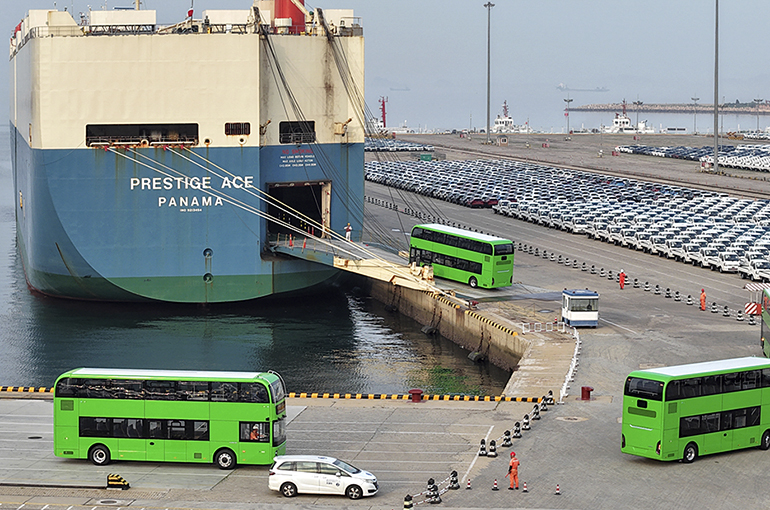
Under the first principle, Eurostat data show that the EU imported 107,000 hybrid vehicles from China in 2024, a figure that rose to 302,000 last year, the person said. Using the 2025 level as a baseline, the two sides agreed on an upward adjustment to the trade arrangement, ensuring room for Chinese producers to maintain exports and achieve steady growth while taking into account the legitimate concerns of industries on both sides based on actual conditions.
Based on the principle of non-discrimination, any measures adopted will not specifically target Chinese products, and China’s quota will be no lower than that granted to any other source of EU imports, the spokesperson said.
Under the compliance principle, both sides confirmed that the trade arrangement must conform to WTO rules, the person said. China retains the right to pursue dispute settlement under the WTO framework and seek trade compensation, among other remedies.
On electric vehicles, spokesperson said China and the EU had achieved a “soft landing” in their anti-subsidy dispute in January. The European Commission has since issued general guidance on price undertakings and will continue to advance the procedures governing company-specific price undertakings, alongside other review procedures.
European Production Drive
With trading arrangements becoming clearer, Chinese automakers are stepping up their localization efforts in Europe. BYD will invest heavily in manufacturing in Europe and build a second and third plant there, with France being shortlisted as the location, Executive Vice President Stella Li said at the 2026 Paris Motor Show that kicked off on Oct. 12. Its factory in Hungary is expected to start mass production before the end of the year, she noted.
GAC’s Aion V and Aion UT models are already being produced in Europe, the automaker said, adding that its European research and development center is expected to be completed and put into operation next year.
Chinese car manufacturers should accelerate the localization of their production capacity in the EU and put down roots in the local industrial chain, National Business Daily reported Cui Dongshu, secretary-general of the China Passenger Car Association, as saying.
At the Paris Motor Show, a number of Chinese carmakers have announced timetables for entering the European market. Aito, co-developed by Seres Group and Huawei Technologies, plans to launch in Europe next autumn. Li Auto will venture into the market in the first quarter of 2027, with its first model, the i6, set to launch first in Norway and the Netherlands under the name Li 6. Xiaomi Auto’s EV models will formally enter the European market next year.
“The change in their overseas expansion model shows that Chinese companies are beginning to turn international business into international capability, continuously building themselves up,” said Fang Yinliang, partner at McKinsey & Company.
Editor: Futura Costaglione