



 Chinese Brands Must Also Build Trust, Not Just Presence to Succeed Overseas, Experts Say at Global Connect Show
(Yicai) June 4 -- Chinese manufacturers have gained global market shares in sectors such as consumer electronics and new energy, but many still struggle to convert product competitiveness into brand recognition. This was a main topic of discussion at the Global Connect Show, which had Yicai Global as media partner.
"Europe doesn't need any more Chinese products, it needs Chinese brands," Jai McIntosh, representative of UK business consultancy Bridgehead and son of its founder, said at the Global Connect Show in Shenzhen on June 1. He has worked with Chinese companies entering European markets.
European consumers still associate many Chinese brands with low-cost positioning, which does not reflect what McIntosh has seen firsthand in China. "I know Chinese brands are not like this, but the perception is still there to a certain extent," he noted.
At the Global Connect Show, executives, retail specialists, and media professionals from Europe, North America, and the Middle East gathered to assess what it actually takes for Chinese brands to build durable overseas footholds.
Overseas markets contributed to around 15 percent of listed Chinese companies' total revenue last year. Despite that, Chinese brands still have a limited presence in the premium segment of overseas markets, even though they are dominant in mass-market categories.
This year will be a critical juncture when entire industries shift from large-scale overseas expansion to higher-quality global integration, according to Roland Berger. The central question is how 'Made in China' can evolve into 'Brands from China' and become embedded in local economies.
"From an innovation standpoint, China is leading in so many areas, both in adopting clean technology products and also in driving that technology forward," said Kyle Field, a freelance journalist covering clean technology, electric vehicles, and energy storage. "As products improve, whether it's a battery, a solar panel, an electric car, or an electric scooter, it starts in Shenzhen first and then goes to the world," she noted.
A freelance contributor who has attended the Global Connect Show for two consecutive years said that more Chinese companies are beginning to think actively about communicating with overseas audiences. "If you want to go beyond your boundary line, you need to move in terms of language and understanding."
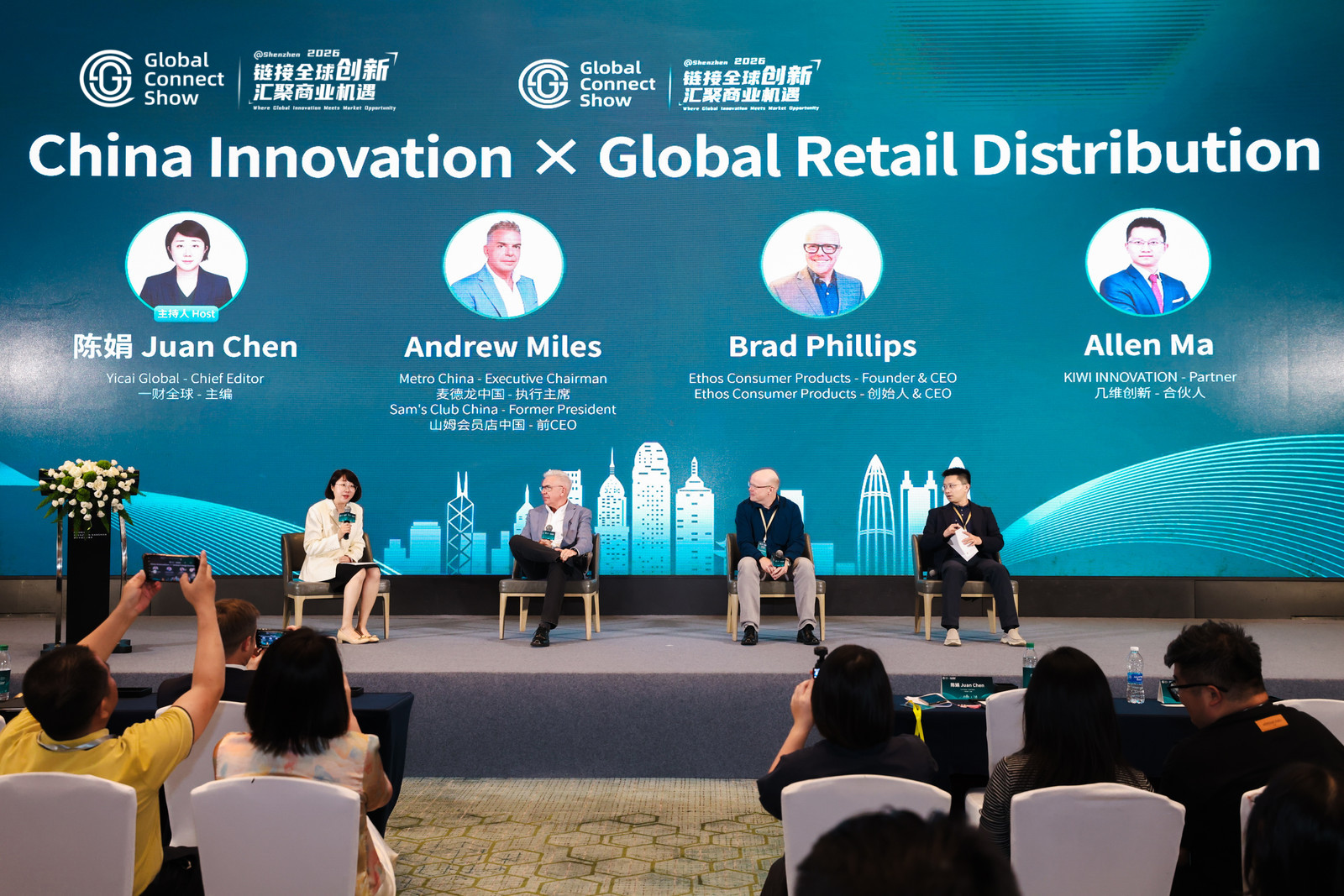
The interface between Chinese innovation and global retail is narrowing, not because overseas markets have lowered their bar, but because Chinese companies are increasingly competing on terms those markets recognize, said Chen Juan, editor-in-chief of Yicai Global, who moderated the forum's roundtable session. The question is no longer whether Chinese brands can make world-class products, but whether they can tell a world-class story about them, she added.
Channel Barriers
Apart from the brand recognition issue, entering overseas retail channels also poses challenges on its own. When evaluating potential partner brands, retailers focus not only on the products but also on the production capacity, compliance qualifications, and organizational structure of the company behind, said Andrew Miles, executive chairman of Metro China and former president of Sam's Club China.
A clear target customer positioning and consistent brand narrative are among the fundamental prerequisites for securing long-term partnerships with retailers, Miles pointed out.
From a buyer's perspective, technology-driven firms face challenges in quickly conveying product value to consumers, said Brad Philips, founder of Ethos Consumer Products. Being able to communicate value with just a price to a customer who is walking by is a crucial ability to gain attention on retail shelves, he added.
McIntosh presented the differences in market entry strategies using two Chinese companies as examples. One opted for an online, rapid market entry approach but encountered scalability bottlenecks after about 18 months. The other took the time to build a local team, establish compliance systems, and streamline channel partnerships, eventually entering more than 200 offline retail stores across Europe.
McIntosh mentioned plans to set up an Asian office in Shenzhen, Shanghai, or Hong Kong. "The product is usually great," he said. "It's more about ensuring that we have an appropriate commercial model that works for both sides."
The Middle East has its own unique characteristics. Allan, a representative from Kiwi Innovation, shared his experience of over a decade working in the region, highlighting that its market structure is relatively fragmented, with differences in consumer habits, religious cultures, and climate conditions across various countries.
He provided an example of a brand that developed a version of smart locks specifically for the high-temperature environment of the Middle East, demonstrating how targeted localization can create differentiated opportunities.
Rhythm Is More Important Than Speed
Despite the craze for brands to go abroad, not going overseas doesn’t mean failure, according to Chris Pereira, founder of iMpact and initiator of this year's GCS. "If you say you won't go overseas this year, that's okay, as the overseas market will still be there next year."
The most frightening thing is to follow the trend of a wave of brands or companies in the same industry, as the likelihood of being eliminated is too high, he noted.
Business founders should conduct on-site visits to gain direct insights into the local market before formally expanding overseas, Peng suggested. Regarding localization strategies, he emphasized that functions such as marketing, sales, and business development should involve local talent, and compliance operations also require the participation of local teams.
However, the standards for outcomes should not be lowered just because a company is entering an overseas market, he pointed out. "In this regard, we must not localize."
Over the past six years, iMpact has served more than 400 Chinese brands and established offices in seven to eight countries. Smart hardware brands Dreame Technology, Lymow, Procolored, Beatbot, and Rokid participated in this year's GCS.
Editor: Futura Costaglione