


 China's Midea, Electrolux to Form Sales JV to Expand in North American Home Appliance Market
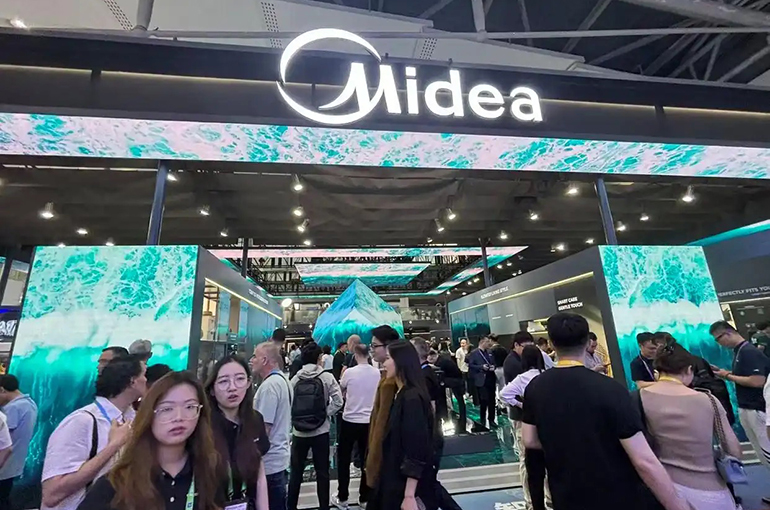
(Yicai) April 28 -- Midea Group and Electrolux will link arms to set up a sales joint venture for refrigerators and freezers to jointly explore the North American market, while the Chinese home appliance giant will also buy into two factories of its Swedish peer in the region.
Midea and Electrolux will establish a 50-50 JV, with the cooperation to launch next quarter, the Stockholm-based company announced recently. In addition, Electrolux plans to sell a 65 percent stake in its fridge plant in Mexico's Juarez and a 45 percent stake in its washing machine and laundry care equipment factory in South Carolina's Anderson to Midea.
Despite its long-term presence in North America, Electrolux's regional business has been mired in losses, pressured by low production efficiency, high manufacturing costs, and fierce competition. The company has gone through multiple rounds of layoffs in recent years and plans to shut the fridge production line at the Anderson plant in July, relocating relevant production to the Juarez factory.
By holding controlling and minority stakes in local plants, Midea will realize localized production in North America, Wang Juan, senior analyst at Industry Online, told Yicai. The move can not only circumvent tariff barriers but also allow the Foshan-based firm to quickly access the mid-to-high-end North American white goods market by leveraging Electrolux's brand influence and offline sales networks, Wang added.
Midea has no factories in North America, so it heavily relies on product exports to develop in the region, Wang pointed out, but added that export costs have surged due to relevant tariffs on Chinese home appliances continuing to rise, greatly limiting its local market expansion.
In addition, Electrolux can revitalize part of its North American assets, recover cash flows, phase out inefficient production capacity, and introduce Midea's mature manufacturing and supply chain systems, Wang said. These measures will help reduce production costs, improve operational efficiency, and hasten business transformation, Wang added.
"China's home appliance industry is shifting from product export to supply chain globalization, with overseas expansion models becoming more diversified and mature," according to Wang. The tie-up will also help raise the concentration ratio of the North American white goods market, drive the transfer of local home appliance production capacity and supply chains to Mexico, and reshape North America's industrial layout, Wang noted.
"The North American white goods market will see intensified competition among European and US capital, Chinese companies, and South Korean firms in the future," Wang stressed. "The deepening ties between Midea and Electrolux will likely steadily lift the regional market share of independent Chinese brands, while competition in the high-end segment of the local home appliance industry will become increasingly fierce."
Electrolux reported a net loss of SEK470 million (USD50.8 million) in the first quarter of this year, with the North American business as a major drag on profitability. Rising US tariffs have pushed up operating costs and dampened market demand, and although the company raised local product prices moderately, the incremental revenue from price hikes failed to offset the increased costs caused by higher tariffs.
Midea and Electrolux share a long cooperation history, with the pair establishing a JV in May 2017 to introduce AEG, a high-end German home appliance brand under Electrolux, to the Chinese market. However, due to underwhelming operational performance, Midea withdrew from the JV in 2020.
In addition, Midea tried buying loss-making Electrolux in the first half of 2023 to fill its gap in mid-to-high-end brand layout across European and American markets, but the two sides failed to agree on the transaction terms.
Editors: Tang Shihua, Martin Kadiev