



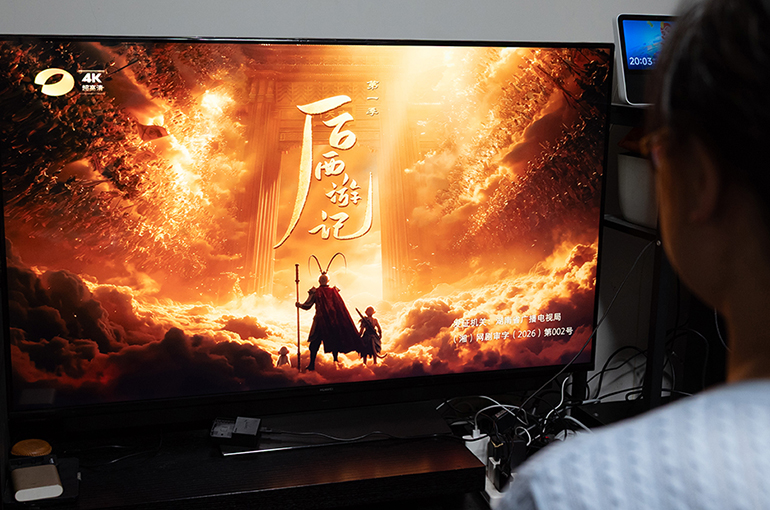
 China’s First AI-Generated Long Drama Makes Prime-Time TV Debut
(Yicai) Sept. 2 -- Artificial intelligence-generated content has made its way into China’s prime-time television, as Hunan Satellite TV, a major broadcaster popular with younger viewers, began airing the country’s first AI-generated long-form drama.
Journey to the West: The Sequel premiered on Aug. 31, with its average viewership rating reaching 0.27 percent and peaking at 0.33 percent, ranking among the top three prime-time dramas on Chinese satellite TV channels that day, according to Huan.TV Big Data, a third-party streaming data provider.
Journey to the West: The Sequel draws on the main characters of the 16th-century Chinese classic Journey to the West, whose 1980s TV adaptation became one of China’s best-known series. Unlike that adaptation, which largely followed the novel, the new AI-generated drama tells an original story.
Produced by Mango TV, the online video platform affiliated with Hunan Satellite TV, the new series uses no human actors, with all visuals and character performances created using AIGC. The first season is planned to have 30 episodes, with the first chapter, Flower and Fruit Mountain, comprising five 40-minute episodes.
The debut could offer an early test of whether AI can reshape the economics of long-form television production by sharply lowering costs and boosting efficiency, though industry insiders cautioned that the technology has yet to prove it can consistently produce hits or generate profits.
High production costs have long constrained the output of long-form dramas, Yu Liangxing, chairman of streaming data provider Gouzheng Data Technology, told Yicai. AI-generated dramas require neither actors nor physical sets and do not need crews to move between shooting locations, significantly reducing content production costs and improving production efficiency, Yu added.
Cost Savings Meet Commercial Risks
The drama also reflects a broader AI push by Hunan Broadcasting System, the parent organization of Hunan Satellite TV and Mango TV.
A manager at Mango Excellent Media, the parent company of Mango TV, said during an interaction with investors on Aug. 31 that AI can help producers cut costs and improve efficiency, though the gains depend on the project type, production standards, and depth of AI involvement.
Mango TV has also launched a dedicated AIGC channel for AI-generated comic dramas, simulated live-action dramas, animation, and other content, the manager said. The platform has set up professional content review and copyright operations teams for the channel to mitigate risks and is exploring ways to generate additional revenue from such content.
“Although AI-generated long dramas can reduce content production costs, it will take time to create hit products,” Zhang Yi, chief executive and chief analyst of iiMedia Research, said, noting that the reason is that this not only requires continuous improvement in the coordination between human content creators and AI, but also the overall recovery of the video content market.
AIGC will diversify the supply of audiovisual content and promote coordinated upgrades to content production and playback tools, Dong Min, secretary-general of the China Video Industry Association, told Yicai. But the underlying principle that “content is king” in the audiovisual market will not change, he added.
The association is developing group standards for AIGC video generation to guide the standardized and orderly development of the industry, Dong said.
AI-generated long-form dramas also face profitability risks, Dong noted. “The business model of AI-generated long dramas has not yet been validated, and even if the viewership ratings of Journey to the West: The Sequel are good, it does not mean that all AIGC dramas can be profitable.”
Under a policy implemented by Chinese regulators last year, producers of audiovisual content created with the involvement of AI must display labels at the beginning and in prominent positions indicating that the content was AI-generated.
Editors: Tang Shihua, Emmi Laine