



 China's Car Sales Plunge 28% in September While Exports Surge 73%
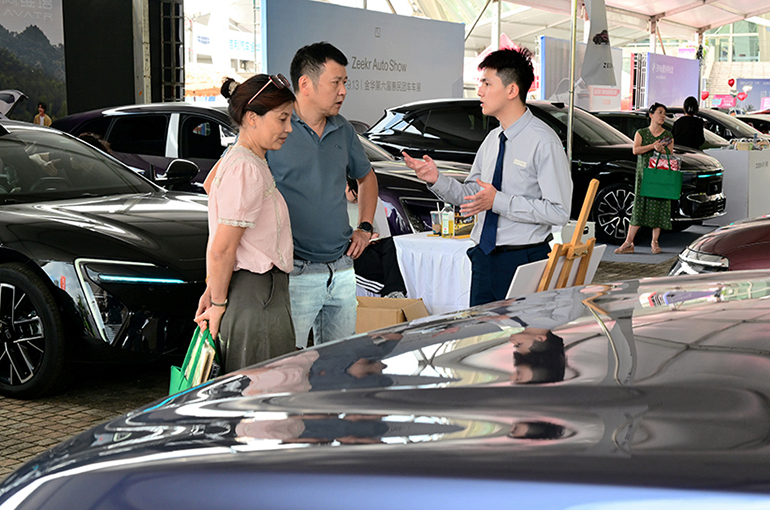
(Yicai) Oct. 13 -- Retail sales of passenger vehicles in China tumbled 28 percent last month from a year earlier, the steepest drop this year, while exports soared 73 percent and accounted for more than half of sales at multiple domestic carmakers.
Passenger vehicle retail sales reached around 1.6 million in September, up 4.9 percent from the previous month, according to data released by the China Passenger Car Association yesterday. Exports topped 923,000 units, a 3.1 percent increase from August.
For the first nine months of this year, car sales dropped 22 percent to 13.46 million units from a year ago, while exports soared 75 percent to 7.07 million units.
The Mid-Autumn Festival holiday falling earlier this year (in late September), combined with high fuel prices, subdued overall consumption, and a high base created by the buying rush ahead of the subsidy phase-out a year earlier, jointly weighed on last month's performance, said Cui Dongshu, secretary general of the CPCA. In addition, artificial intelligence-driven price increases for memory and chips slowed the rollout of new electric models, he added.
Fuel vehicle retail sales plunged 43 percent, with that of pure fuel models down 49 percent and ordinary hybrids up 25 percent. Sales of new energy passenger vehicles fell 17 percent to 1.08 million units, but new energy vehicle adoption rose to a record high of 67 percent, up from 58 percent a year earlier.
Growing Export
New energy passenger vehicle exports skyrocketed 164 percent to 558,000 units in September from a year ago, accounting for about 60 percent of the total, compared with 39.8 percent a year earlier. Battery electric vehicles made up 61 percent of the total electric car exports, followed by plug-in hybrids at 34 percent, and extended-range EVs at 5 percent. BYD, Chery Automobile, and Geely Automobile Holdings led NEV exports with 176,000, 86,000 and 73,000 units, respectively.
In addition, wholesale passenger vehicle sales fell 8.9 percent to 2.55 million units, with the decline about 19 percentage points narrower than retail sales, thanks to a lift from exports.
As the Chinese market weakens, exports have become a core focus for some automakers and are supporting their wholesale sales and profits, Cui said, adding that exports account for more than 50 percent of total sales at some manufacturers, while the number of those where the export share topped 70 percent is also rising rapidly.
Impact of China-EU Consultations
The trade environment for Chinese carmakers in Europe has drawn attention amid rising exports. China's Ministry of Commerce said on Oct. 12 that the country and the European Union have continued their dialogue under the China-EU trade and investment consultation mechanism, held intensive consultations on trade in hybrid and EVs, and reached several points of consensus.
On hybrid vehicles, the two parties confirmed three basic principles: respect for facts, non-discrimination, and compliance with World Trade Organization rules. On EVs, the ministry said the EU will continue to advance procedures related to companies' price undertakings, as well as other review procedures. The pair previously held consultations on the EU's anti-subsidy case on EVs, and the EU issued a general guidance document on price undertakings in January.
Resolving trade disputes through negotiation, rather than simply imposing tariffs, would give Chinese automakers a more stable and predictable environment in the EU, Cui pointed out. Under the new arrangement, Chinese PHEV exports to the EU may decline next year, but PHEVs account for only a little over 30 percent of NEV exports, while BEVs account for about 60 percent, so the impact on BEVs and overall exports will not be particularly large, he added.
Central and South America, Australia, the Middle East, Africa, and other markets still hold considerable growth potential for PHEVs, Cui stressed.
Chinese automakers cannot rely solely on exporting finished vehicles and need to localize their operations, as Japanese and South Korean rivals have, serving local supply chains, Cui said, noting that peripheral regions of the EU, such as Hungary, Spain, and Italy, could become their bases.
Looking ahead, retail sales of passengers in China will likely remain flat or slightly increase this month from September, with year-on-year declines narrowing in October and November, reaching as low as 10 in December, Cui added.
Trade pressure in the EU is rising, with the slowdown in export growth expected to become visible gradually, according to the CPCA.
Editor: Martin Kadiev