



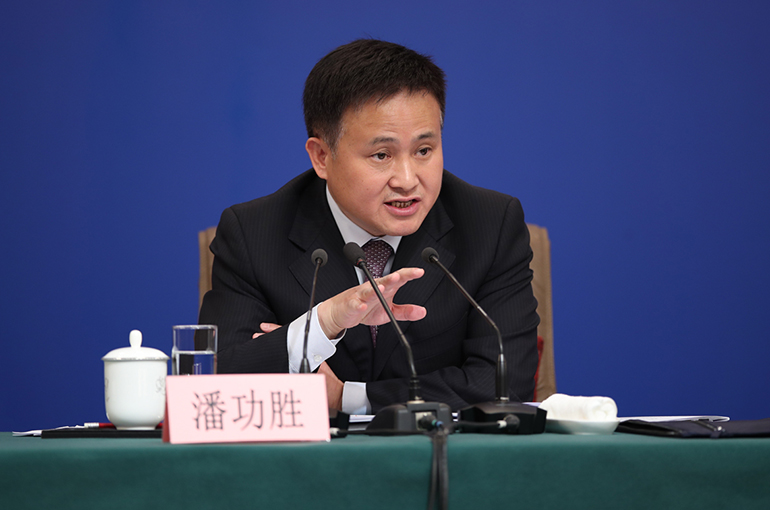
 China Has No Intention to Weaken Yuan to Gain Trade Edge, PBOC Governor Says
(Yicai) Sept. 3 -- China has neither the need nor the intention to use currency depreciation to gain a competitive advantage in trade, Pan Gongsheng, governor of the People’s Bank of China, said at a recent G20 meeting of finance ministers and central bank chiefs in the United States.
China operates a managed floating exchange-rate system, which allows market forces to play a decisive role in determining the exchange rate while guarding against the self-reinforcing effects of herd behavior and irrational expectations in the financial markets, Pan said at this year’s second G20 Finance Ministers and Central Bank Governors’ Meeting which was held in Asheville from Aug. 31 to Sept. 1.
In recent years, as China’s export structure has upgraded and evolved, companies’ pricing power and ability to manage exchange-rate risks have continued to improve, Pan said at the forum where officials discussed the global economic outlook, measures to promote economic growth, global imbalances and sovereign debt in developing countries.
As a result, China’s trade has become significantly less sensitive to exchange-rate movements, Pan said. Exporters are making greater use of exchange-rate hedging tools, while the yuan’s share of trade settlement has continued to rise, further reducing the sensitivity of trade to exchange-rate fluctuations.
The redback has been strong this year. The onshore yuan had appreciated 3.88 percent against the US dollar year to date as of 3 p.m. on Sept. 3 to reach 6.7181, according to Wind data. The offshore yuan stood at 6.7173, representing a 3.7 percent gain. And the China Foreign Exchange Trade System RMB Exchange Rate Index, which measures the value of the yuan against a basket of 24 currencies, was up 3.96 percent on Aug. 31 from the end of last year at 101.87.
The role of China’s exchange-rate policy has shifted from stabilizing the competitiveness of foreign trade to maintaining financial stability and advancing the internationalization of the yuan, Pang Ming, a member of the China Chief Economist Forum, told Yicai.
In terms of monetary policy, Pan said the PBOC is continuing to transform its monetary-policy framework and improve the interest-rate system. It is also implementing a moderately accommodative monetary policy to create a suitable monetary and financial environment for stable economic growth and the smooth operation of financial markets.
On the issue of global imbalances, Pan said that rising trade protectionism, the broadening of national security concerns and an unpredictable policy environment are important factors behind the worsening of global imbalances.
Solving imbalances requires countries to pursue their own structural reforms, he said. Deficit countries should reduce fiscal deficits and raise savings rates, while surplus countries should appropriately promote consumption and investment growth. All countries should make medium- and long-term commitments and firmly implement them, he added.
Pan said China has never deliberately pursued a trade surplus and has made the transformation and upgrading of its economic structure a strategic priority under the 15th Five-Year Plan for social and economic development.
Editor: Kim Taylor