



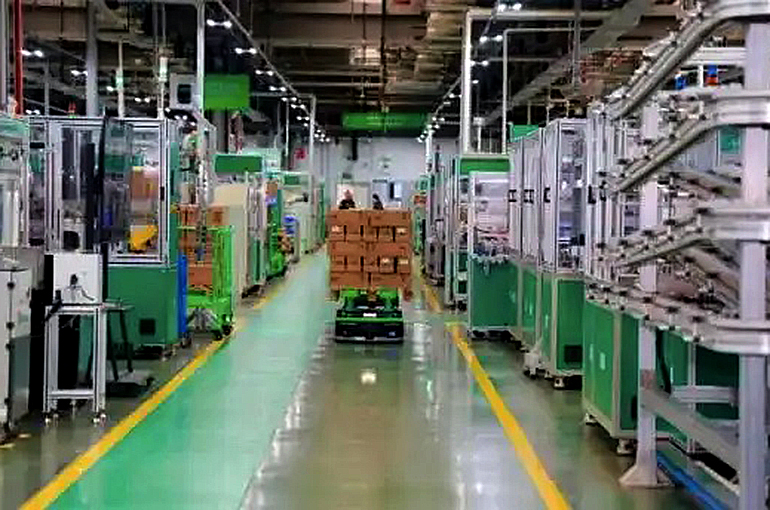
 China Has World’s Most Lighthouse Factories
(Yicai) Jan. 23 -- China ranks first globally for number of lighthouse factories -- manufacturing plants that use Fourth Industrial Revolution technologies such as artificial intelligence and advanced robotics at scale -- after the World Economic Forum named a new batch of sites.
Sixteen lighthouse factories in China were added to the WEF’s Global Lighthouse Network on Jan. 15, accounting for about 70 percent of new additions and bringing the country's total number to 101. There are now more than 220 sites across 35 countries and more than 30 industries.
Co-founded by the WEF and McKinsey & Company in 2018, the GLN recognizes leading industrial sites and value chains that have successfully scaled 4IR technologies, and serves as a platform to showcase and disseminate best practices that deliver step-change improvements in financial performance, operational excellence, and sustainability through the transformation of factories, value chains, and business models.
China’s newly added sites include some plants of foreign multinationals, including those of France’s Schneider Electric, Michelin, and Forvia in Wuhan, Shenyang, and Yancheng, respectively, as well as Germany’s Zeiss Optics and Siemens in Guangzhou and Nanjing. They illustrate both the strategic upgrading of foreign investment in China and the shifting global standing of China’s supply chains.
Schneider Electric's Wuhan factory is one of only three Talent Lighthouses globally because it has developed a workforce training and empowerment model tailored for the digital era.
Last September, the GLN revised its classification scheme, replacing the original three categories -- Sustainability Lighthouses, Factory Lighthouses, and End-to-End Value Chain Lighthouses -- with the five categories of Customer-Centric, Productivity, Supply-Chain Resilience, Sustainability, and Talent.
“We’re merely pursuing efficiency, as lean production and just-in-time manufacturing are no longer sufficient," Zhang Kaipeng, senior vice president of Schneider Electric and head of global supply chain for China, told Yicai during a visit to its Wuhan plant on Jan. 21.
"The current environment has brought greater uncertainty, and relying on a single supplier poses enormous risks," he said. "We must build supply chains that are lean, agile, resilient, efficient, and green."
To address new supply-chain challenges, talent has become a core engine driving technological innovation and ecological collaboration along with the in-depth integration of digital technologies represented by artificial intelligence, Zhang noted. It is the enduring momentum for transformation, he added.
Besides talent advantages, the reasons foreign firms are increasing investment in China include the country’s vast market and its unmatched supply-chain efficiency. Customized services that meet local needs precisely have become the key to strengthening their global competitiveness.
Zeiss' Guangzhou factory leverages technologies such as machine learning, digital twins, and intelligent agents to customize optical lenses based on a customer’s age, visual needs, and lifestyle, according to the WEF's awards information.
These technologies have helped the plant expand the range of personalized products by 400 percent, shorten delivery cycles by 29 percent, increase the on-time delivery rate to over 98 percent, and lift customer satisfaction to 99 percent.
Michelin's Shenyang plant, recognized as a Production Efficiency Lighthouse, has accelerated the layout of new energy vehicle tire products in recent years, with the number of product specifications surging 340 percent to more than 250. Meanwhile, its minimum order quantity dropped 71 percent, and its trial production delivery cycle was halved.
The Shenyang factory’s development from local manufacturing to global intelligent manufacturing has contributed to the upgrading of China's manufacturing industry, said Philippe Verneuil, president and chief executive of Michelin China and Mongolia.
Entering the WEF's Global Lighthouse Network is a testament to Michelin's more than 30 years of deep-rooted development and persistent innovation in China, Verneuil pointed out.
Some 61,207 new foreign-invested enterprises were established in China in the first 11 months of last year, up 17 percent from a year earlier, according to commerce ministry data.
Foreign investment in actual use in China surged 26 percent in November alone, as sectors such as AI, the digital economy, and green low-carbon development continue to attract substantial investment despite the contraction in global cross-border investment, according to the ministry.
Editor: Futura Costaglione