


 AI Innovation, Global Partnerships Are Hot Topics at 2026 Zhangjiang Pharma Valley Conference, BioShanghai Week
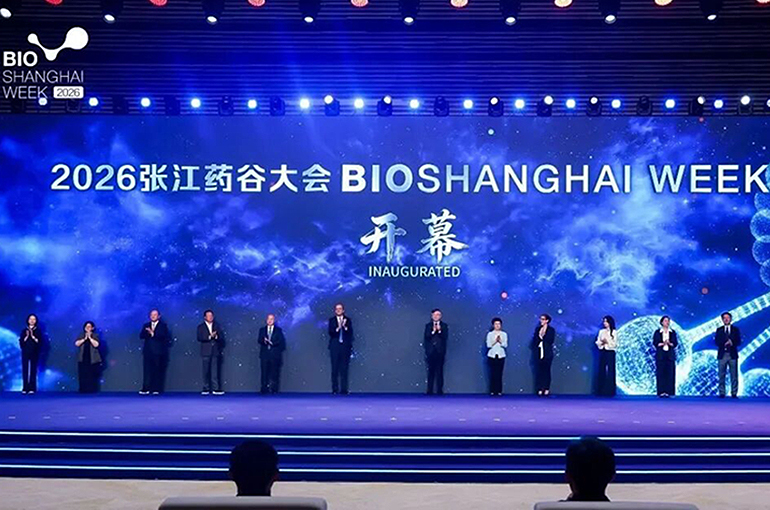
(Yicai) Sept. 18 -- The 2026 Zhangjiang Pharma Valley Conference and Shanghai International Biopharmaceutical Industry Week, or BioShanghai Week for short, has opened in Shanghai, highlighting global partnerships and artificial intelligence-driven innovation.
Themed ‘AI-Driven Innovation, Building a Global Health Community,’ the four-day event kicked off yesterday and will run through Sept. 20. It brings together government officials, executives, scientists, and investors from China and abroad to discuss innovation integration, clinical transformation, capital empowerment, ecological services, collaboration among medical institutions, and global partnership.
BioShanghai Week was rebranded this year for its sixth edition, introducing a new name. It was co-organized by Shanghai Zhangjiang Pharma Valley Ecosystem Technology Development and Yicai Global’s sister company Shanghai Yicai Wanxiang Information Technology.
Li Zheng, member of the Shanghai Municipal Party Committee Standing Committee and secretary-general of the Communist Party of China Pudong New Area Committee, and Yang Sheng, deputy director of China's National Medical Products Administration, addressed the opening ceremony along with Jane Wall, director general of the UK BioIndustry Association.
China has approved 59 innovative drugs so far this year, Yang said. Of them, Shanghai had approved six domestically developed Class 1 innovative drugs as of Sept. 4, according to data disclosed at the event. The city's biopharmaceutical manufacturing output reached CNY138.2 billion (USD20.6 billion) in the first eight months of the year.
Two platforms were launched at the opening ceremony. One is a Shanghai-London life sciences partnership involving Zhangjiang Group and other institutions, such as Imperial College London and Oxford University Innovation; the other is a financing initiative bringing together domestic and international investors, including Shanghai Industrial Investment, CBC Group, and Hillhouse Capital, to support biopharma companies across their full lifecycle.
Growing Role of Chinese innovation
China accounted for around 30 percent of the global pharmaceutical pipeline last year, up from just 2 percent in 2015, Allan Gabor, operating partner at Advent International and former President of Merck China and EVP Merck Electronics, said at BioShanghai Week, citing McKinsey data. This shift has changed how multinational companies seek partnerships in China, he noted.
However, Gabor warned that a pipeline is not a promise, explaining that innovation should be measured by patient outcomes and affordability rather than approval volume alone.
Carvykti, a Chinese cell therapy developed through international collaboration, is an example of science translating into patient benefit, Gabor said, calling for closer coordination on regulatory approval, financing, and clinical readiness to close gaps in patient access, including in Southeast Asia and Africa.
Chinese biopharmaceutical assets have continued to draw international capital, said John Arbuckle, global co-head of biopharma mergers and acquisitions at J.P. Morgan. In the first half of the year, Chinese drugmakers signed about 100 cross-border deals worth about USD100 billion, with USD5 billion in upfront payments. Last year, they signed 158 deals worth USD136 billion.
Platform deals, such as those involving AstraZeneca and CSPC Pharmaceutical Group, or Pfizer and Innovent Biologics, have become more common, Arbuckle noted, adding that deal activity has grown beyond oncology into areas including neurology and women's health.
From a modality perspective, small molecules, antibodies, and antibody-drug conjugates have expanded meaningfully into polypeptides, fusion proteins, and oligos, he pointed out. “China is no longer 'me-too,' 'me-different,’ or 'me-better’ -- we are starting to see truly innovative science.”
AI Integration
AI was featured prominently in panel discussions, with executives disclosing both progress and remaining obstacles.
Translating AI-designed molecules into physical compounds remains a bottleneck, particularly for complex small molecules and cyclic peptides, said Zhang Peng, biopharmaceutical general manager at Beijing Deep Potential Technology. He called for closer integration between computational models and automated laboratories.
Organizational trust by employees and scientists in AI-generated results is the main challenge enterprises face in terms of adoption, said Tang Fei, head of information technology and AI at Hutchmed.
Meanwhile, Rosie Rodriguez, president of growth at London-based Relation Therapeutics, said pharmaceutical research and development still often runs wet-lab and computational work in parallel rather than as a continuous feedback loop.
Shanghai Strengthens Access to Innovative Treatments
Shanghai is working to facilitate the clinical adoption of innovative drugs and medical devices by improving hospital access and payment mechanisms.
Hospitals must ensure that innovative products can enter their facilities without restrictions based on drug quotas or drug-to-medical-consumable ratios, said Zhang Chao, deputy director of the Shanghai Municipal Healthcare Security Administration.
Medical institutions must convene pharmacy committee meetings within one month after the implementation of national reimbursement drug and emerging medical device lists, ensuring that eligible products are stocked, Zhang noted. Shanghai's medical insurance payments for innovative products totaled nearly CNY20 billion (USD3 billion) in 2024 and 2025 combined, he added.
Shanghai is also expanding commercial insurance products, such as the Shanghai Huibao, to complement its basic medical insurance system, as part of a broader effort to diversify payment channels for innovative treatments.
Editor: Futura Costaglione