



 AI Can Cut Costs and Open Doors for Young Creators, SIFF Participants Say
(Yicai) June 24 -- Artificial intelligence can reduce production costs, improve efficiency, and lower barriers to entry for aspiring filmmakers, participants at the Shanghai International Film Festival said, as the technology gains a larger role in film and television production.
Industry professionals said AI is expected to reshape filmmaking by enabling smaller creative teams and helping young creators develop and present projects to investors, although they stressed that human creativity, emotion, and artistic judgment remain irreplaceable.
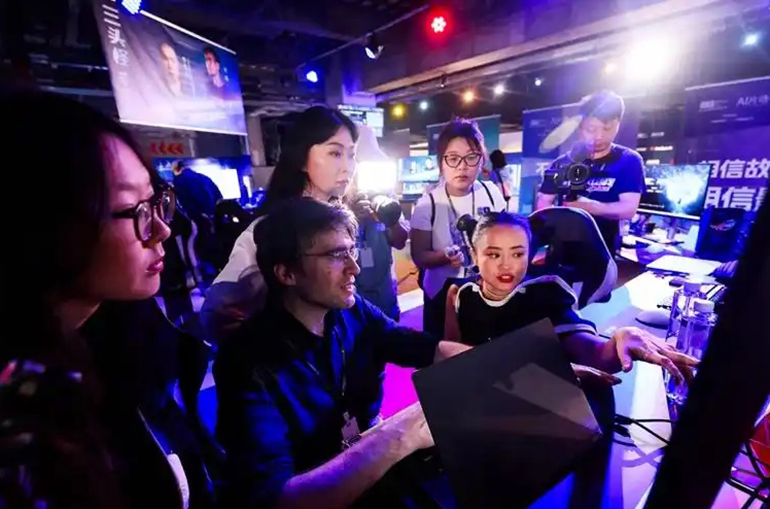
The comments were made during activities surrounding the inaugural “AI Backlot” section at this year’s SIFF. The new exhibition platform showcased AI-enhanced visual works created by four teams pairing filmmakers with “AI super creators,” a term that refers to both professionals proficient in AI technologies and various AI models.
The teams presented their complete production processes and discussed the future of AI applications in film and television during the showcase.
Filmmakers also expressed hope that AI will eventually enable entirely new forms of visual storytelling rather than simply serving as a lower-cost substitute for conventional productions.
AI Films Need Human Creativity
“Film art must be created by humans,” said film director Huang Lei, a member of one of the production teams. “It requires human emotions, intuition, and emotional judgment, which AI cannot and should not replace.”
In Huang’s view, AI functions more as a versatile assistant capable of performing reasonably well across a wide range of tasks. “Therefore, I must learn to use AI because this technology will definitely penetrate into the traditional film and television creation process,” he said.
For filmmakers, AI’s biggest contribution is improving efficiency and lowering costs. Tasks that once required a team of 25 people may now be completed by only four, Huang noted.
He added that AI technology will also lower barriers to entry for young filmmakers by giving them a tool to attract investment. AI-generated sample reels can provide investors with a more intuitive basis for evaluating projects.
The high cost of gaining practical experience in the film industry had prevented many aspiring creators from entering the field before AI technology became widely available.
“A large number of young people who love movies did not have the opportunity, because no one was willing to invest hundreds of thousands or even millions of yuan in a first-time filmmaker,” Huang said.
AI Opens New Opportunities for Young Creators
Producer Ren Ning said many young creators now attach AI-generated sample videos when submitting scripts, helping producers and investors better visualize the stories directors want to tell and how they plan to present them.
Li Xinxin, a member of another AI creation team and a master's student at the Communication University of China, said AI has created new opportunities for young creators.
“AI allows me to create my own works, express myself, and make them seen by more people,” Li said. She currently operates a studio specializing in animation production and said she hopes to produce feature-length animated films in the future.
With AI technology, “new productive forces are no longer limited to large companies, but may also emerge from very small creative units,” said renowned director Huang Jianxin, the initiator of the AI Backlot section. “AI tools can turn creators’ ideas into visuals faster,” he added. In China's policy discourse, "new productive forces" refers to new sources of productivity driven by technological innovation.
Renowned director Yu Baimei, a member of the expert advisory team for this year's AI Backlot section, said he hopes AI technology will eventually produce content that traditional film and television production cannot achieve.
“It’s not meaningful at all for AI to just generate ‘affordable alternatives’ for traditional films and TV series,” he said.
Over the past two years, many talented but inexperienced young creators have emerged and used AI to develop entirely new visual languages that only AI can produce, Yu noted. "Perhaps this is the future of AI applications in films.”
However, Yu cautioned against using AI-generated films to replace live-action productions in the near term. “It’s better not to use AI-generated films to replace live-action productions within the next two years, as audiences can still readily distinguish AI-generated footage from live-action scenes.”
Audiences would strongly criticize producers who sacrifice quality in an effort to reduce costs, he concluded.
Editors: Tang Shihua, Emmi Laine