



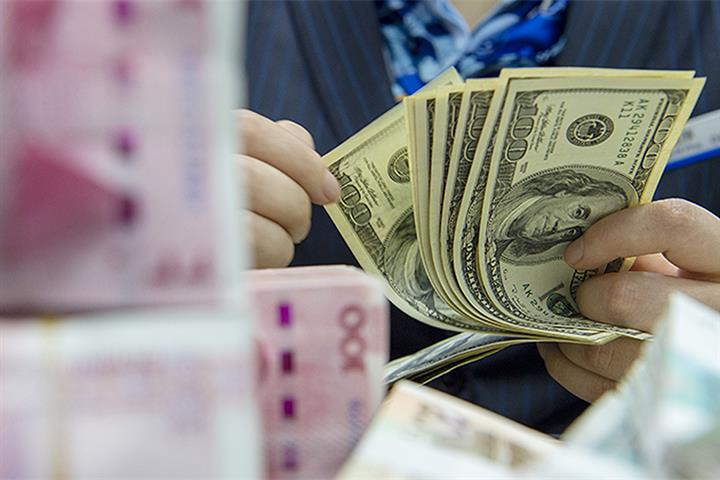
 Weakening Chinese Yuan Is Not Behind Mainland Stock Rout, Analysts Say
(Yicai Global) April 28 -- The rapid depreciation of the Chinese yuan against the US dollar in the last 10 days is not the main culprit behind the recent stock market slump on the mainland, and the yuan’s devaluation will halt soon, market analysts said.
The slump in the mainland stock markets is not directly related to the weakening of the yuan, Zhao Qingming, deputy dean of China Foreign Exchange Investment Research Institute, told Yicai Global.
The Shanghai Composite Index has lost 9.6 percent in value since the start of the month, and the Shenzhen Component Index 15.5 percent. This has coincided with the yuan hitting its lowest level against the US dollar since mid-November 2020. The offshore yuan was trading at 6.6451 at 12:15 p.m. China time today.
Fluctuations in the exchange rate is one factor that foreign investors will take into consideration when deciding whether or not to hold yuan-denominated assets but it is not a major one, said Guan Tao, global chief economist at BOC International China. The exchange rate's resilience, not its rise and fall, is what overseas investors are most concerned about.
There is no panic on the forex market, Guan said. Depreciation expectations fell quickly after the central bank said on April 25 that it will lower the amount of foreign currency banks need to hold as reserves to help support the yuan.
"Does the stock market drive the forex market or does the forex market drive the stock market. I personally prefer the first statement," Zhao said. "Large-scale foreign capital selloffs on the bourses will trigger forex purchase needs, which in turn will result in a softening exchange rate by impacting the balance of forex supply and demand," he added.
Between April 19 and April 25, there were three trading days when foreign capital inflows on the Shanghai-Hong Kong and Shenzhen-Hong Kong stock connect schemes, which allow international and mainland investors to trade stocks in each other’s markets through their home exchange, reached CNY15.2 billion (USD2.3 billion) and there were two trading days when foreign capital sales came to CNY4.6 billion (USD698.3 million).
Overseas investors do not have much say in the pricing of Chinese stocks. As of the end of March, mainland shares purchased with foreign capital only accounted for 4.5 percent of the stocks in circulation. On the mainland, Chinese investors are still the main traders and price setters.
Yuan Expectations
There is only a slim chance the yuan will tumble past 6.7 per US dollar, Zhao said. The redback was the best performer among the major non-US dollar currencies, and there are no fundamental changes in market expectations. As production in the country gets back to normal after a series of Covid-19 shutdowns, current account and cross-border capital flows will remain in surplus. This will maintain a basic balance in cross-border revenue and expenditure as well as domestic forex supply and demand.
The yuan may fall to about 6.7 against the greenback in the third quarter, according to Xie Yaxuan, chief macro analyst at China Merchants Securities. But over the course of the year, the US dollar index will fall back and the yuan exchange rate could rebound and even challenge the 2015 high of 6.04.
Editors: Liao Shumin, Kim Taylor