



 Shanghai Targets USD12 Billion Satellite Internet Industry, 3,000 Orbiting Satellites by 2030
(Yicai) Oct. 28 -- Shanghai has set out plans to create a globally influential satellite internet industry worth more than CNY80 billion (USD12 billion) by 2030, with over 3,000 satellites in orbit.
To achieve this ambition, the city’s new four-year action plan, unveiled at the Satellite Internet Industry Ecosystem Conference in Shanghai yesterday, aims to cultivate in excess of 100 high-quality market entities, develop more than 100 benchmark demonstration applications, and commercialize over 100 scientific research achievements.
Satellite internet involves putting communication base stations in space, and represents a new type of integrated information infrastructure that uses satellite constellations to provide broadband internet access to devices on the ground, at sea, and in the air. The industry behind this extends beyond satellite production to include communications equipment, semiconductors, ground terminals, launch services, software, and internet-based applications.
Major progress in satellite internet performance depends on breakthroughs in underlying optoelectronic technologies, Chu Junhao, an academician at the Chinese Academy of Sciences, said at the conference.
Continued research in areas such as core chips and new semiconductor materials is needed, as technological advances will be essential to slash power consumption and costs for satellite platforms and ground terminals, thereby laying a solid foundation for the mass deployment of space information systems, Chu pointed out.
The Spacesail Constellation, developed by Shanghai-based Yuanxin Satellite Technology and also known as the Qianfan project and the G60 Starlink, is China’s first mega low-orbit commercial satellite constellation to enter the formal networking phase. Once fully deployed, it will have more than 15,000 low-orbit satellites. To meet the basic requirements for commercial operation, 256 broadband satellites have been launched so far and that is expected to reach 324 by the end of this year.
The conference also marked the launch of preparations for a satellite internet industry fund, which will be jointly established by investment platforms affiliated with Shanghai's municipal and district-level governments, together with private sector investors.
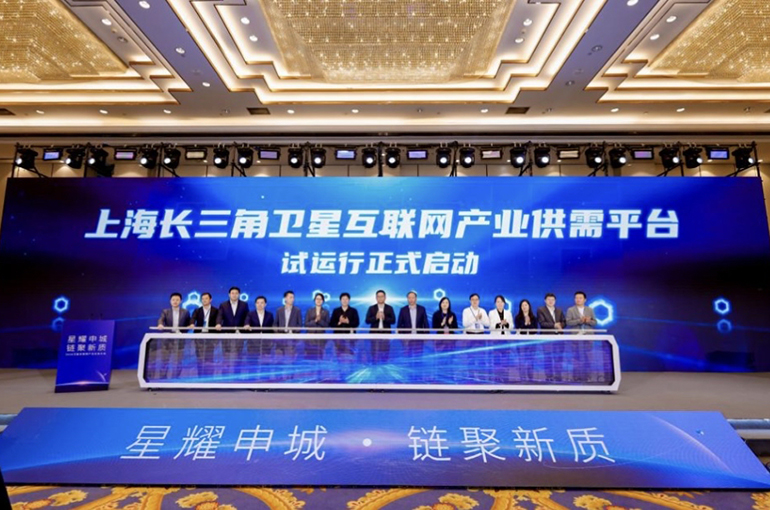
In addition, trial operations began for the Yangtze River Delta Satellite Internet Industry Supply-and-Demand Platform. Focused on satellite internet and next-generation communications supply chains, it aims to resolve persistent bottlenecks such as poor information exchange and inefficient resource matching between upstream and downstream industry players.
The platform will drive new business growth for companies by boosting efficient industrial collaboration and resource matching across the Yangtze River Delta, Li Changhao, secretary-general of the Shanghai Yangtze River Delta Emerging High-End Industry Promotion Center, told Yicai.
It has already collected more than 2,000 supply-and-demand information entries and facilitated matchmaking for more than 100 organizations, supporting core functions including publishing supply-and-demand lists, maintaining a database of business cooperation enquiries, and providing intelligent matching services, Li said.
Editors: Tang Shihua, Martin Kadiev