



 Repeat Purchase Rate Is Top Indicator to Evaluate Humanoid Robot Industry, UBS Analyst Says
(Yicai) May 20 -- Despite record growth in shipments and financing amount last year, the better indicator to evaluate the development of the humanoid robot industry is the repeat purchase rate, according to an analyst covering the Chinese industrial sector at UBS Securities.
What matters more than shipment volumes is whether industrial customers who received early-stage androids are willing to place more orders, Phyllis Wang told Yicai. “If repeat orders start coming in from those customers, that would be a meaningful leading indicator for genuine mass production ahead.”
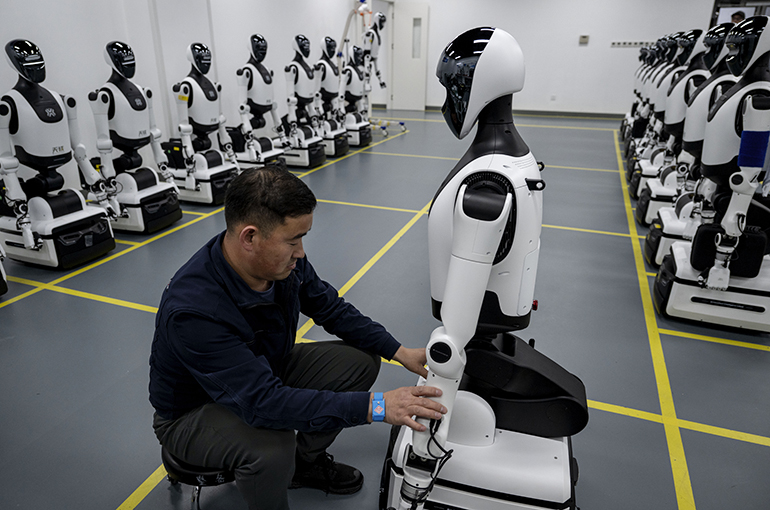
Global shipments of humanoid robots reached about 18,000 units last year, with sales value surging over sixfold to USD440 million, according to figures from International Data Corporation. Chinese manufacturers dominated the market, with AgiBot and Unitree Robotics each achieving shipments of about 5,000 units.
However, most of the shipped androids went to research and development and data collection centers, or were used for commercial applications, such as entertainment scenarios, Wang said. “Units deployed in actual industrial settings remain relatively limited.”
UBS forecasts global humanoid robot shipments to hit 30,000 units this year. Wang believes that the figure is conservative relative to broader market expectations and carries upside risk.
IDC projected in April that global humanoid robot shipments will exceed 510,000 units by 2030, a compound annual growth rate of nearly 95 percent.
The global android industry’s fundraising amount tripled to USD5.2 billion from the year before, with the United States and China accounting for more than 50 percent and nearly 40 percent, respectively, Wang said, citing statistics from PitchBook Data.
China's embodied intelligence industry raised CNY37.9 billion (USD5.2 billion) in 2025, more than four times the amount the year before, with Unitree, AgiBot, and other leading companies reaching valuations of over CNY10 billion each, according to data from information service provider ITjuzi.
Where Does the Industry Stand?
Wang used the classification for autonomous driving from Level 1 to Level 5 also for humanoid robots. “Because we believe achieving L5 in humanoid robots is harder than in autonomous driving, so that's a useful benchmark to watch.”
If humanoid robots were classified from L1 to L5, today's mass-produced androids would be at Level 3, which means that they are capable of handling a defined set of tasks in supervised conditions, Wang said.
She believes that building a truly general-purpose humanoid robot is harder than achieving L5 autonomous driving. In fact, she predicted that once L5 autonomous driving achieves broad real-world deployment, the era of general-purpose humanoid robots will likely be right behind.
"The artificial intelligence brain model and the lack of training data remain significant bottlenecks," she pointed out. “That hasn't changed.”
Real-World Signal
In April, China’s State Grid issued a plan calling for the procurement of about 8,500 embodied intelligence devices this year, with a total investment of around CNY68 billion, targeting power grid inspection, live-wire operations, emergency rescue, and warehousing and logistics.
The plan includes 500 humanoid live-wire operation robots with a budget of CNY25 billion, equal to around CNY5 million (USD733,960) per unit, for use in high-risk scenarios, including distribution network live-line work and ultra-high-voltage projects.
Wang sees this plan as a signal of a structural shift in demand. "More downstream industries want humanoid robots to handle genuinely dangerous work, not just for data collection centers, entertainment, or research purposes," she explained.
"The State Grid order reflects a desire to deploy robots in settings that are truly hazardous," she added. “That is a meaningful shift from what we saw before.”
If Southern Power Grid and regional energy groups follow with comparable procurement, industry insiders expect the total investment in embodied intelligence across China's electricity sector to exceed CNY100 billion (USD14.7 billion) this year.
Who Benefits First
To investors looking to position ahead of large-scale commercialization, Wang recommended focusing on upstream component suppliers over the next three to five years, a time when it remains difficult to identify which robot maker will prevail.
In fact, regardless of which manufacturer ultimately wins, components such as ball screws, gear reducers, dexterous hands, and AI chips will still be indispensable.
Wang stressed that supply chain capacity is not the binding constraint. "The bottleneck now is the product itself," she noted. “Once the technology gap is closed and products meet what downstream customers actually need, the ramp-up should be fast.”
Editor: Futura Costaglione