


 Overturning the Century-Old Dogma of 'Necrosis': Interview With 2026 WLF Prize Laureate in Life Science or Medicine Prof. Yuan Junying
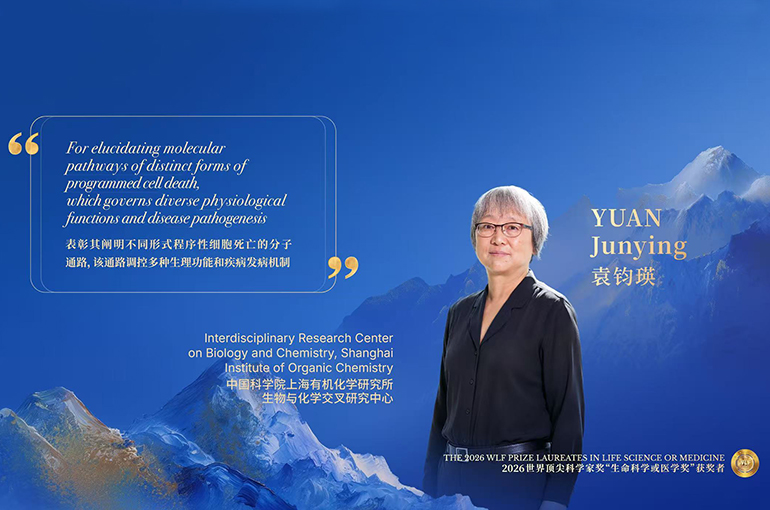
(Yicai) Oct. 26 -- Professor Yuan Junying is director and senior investigator of the Interdisciplinary Research Center on Biology and Chemistry at the Chinese Academy of Sciences' Shanghai Institute of Organic Chemistry and a 2026 WLF Prize Laureate in Life Science or Medicine.
Her discovery of caspases ushered the global research community into an era of unraveling the molecular mechanisms of apoptosis. She was the first to overturn the century-old dogma that necrosis is a passive, disordered process, and pioneered the definition of the molecular pathway of programmed cell necrosis (necroptosis).
Her molecular discoveries underpin research into devastating neurological and cerebral diseases including Alzheimer's disease and amyotrophic lateral sclerosis, as well as the development of targeted interventions for chronic inflammation and pathological damage triggered by aging. These foundational discoveries have made lasting contributions to protecting human health.
In this in-depth interview, Yuan discusses the molecular code of cell death, the breakthrough development of novel RIPK1 inhibitors, and her scientific perseverance forged over four decades of research with characteristic rigor, confidence, and passion.
1. On Receiving the WLF Award: 'Winning a Prize Has Never Been the Goal. I aspire to Translate my Research Findings Into New Drugs to Help Patients'
Q: As the recipient of the 2026 WLF Prize Laureate in Life Science or Medicine, what are your reflections on the honor?
Yuan: Winning a prize has never been my research goal. My aim is to translate my research findings into new drugs for treating neurodegenerative diseases and help patients. That was the commitment I made more than 40 years ago, and it remains unchanged. That said, winning this award helps more people understand the significance of my work, which in turn helps me fulfill that goal I set over four decades ago.
2. Breakthrough: 'Inhibiting Necroptosis Is Therapeutic Target for Treating Neurodegenerative Disorders'
Q: Your work on programmed cell death and the necroptosis pathway has been epoch-making. If you were to explain necroptosis to a non-biologist using a simple everyday analogy, how does necroptosis help the body safeguard the health of our nerves and brain?
Yuan: Programmed cell death, also known as apoptosis, is an essential, highly genetically regulated form of cell death during the development of multicellular organisms. During development, neuronal apoptosis eliminates excess nerve cells. Throughout human life, apoptosis plays a critical role in removing abnormal cells that could become tumor cells.
My first discovery in the early 1990s uncovered the molecular mechanism of apoptosis. I found that caspases mediate apoptosis, ushering the global scientific community into an era of research on the molecular mechanisms of apoptosis.
By contrast, the necroptosis I discovered serves as a key mechanism underlying pathological cell death in neurodegenerative diseases. Therefore, inhibiting necroptosis represents a therapeutic target for treating neurodegenerative disorders.
3. Overcoming the Bottleneck: 'Chemistry Was Indispensable to Our Work'
Q: You were the first to break the dogma that necrosis is a passive, disordered process, discovering the RIPK1-mediated necroptosis pathway. As you challenged established scientific orthodoxy and searched for this key target, what were the toughest technical bottlenecks and sources of resistance, and how did you overcome them?
Yuan: I started my research on necrosis in the mid-1990s, a time when the apoptosis field was booming, and I could easily have ridden that wave. Venturing into a new research field carries enormous risks, yet I saw this as a question I could not avoid. I had to rise to the challenge. Later, we defined necroptosis using chemical biology.
We identified Nec-1, the small-molecule inhibitor of necroptosis, fairly quickly. But pinpointing its target, RIPK1, proved much harder. Thanks to our deep understanding of cell death pathways, we uncovered that Nec-1 suppresses RIPK1 kinase activity. Chemistry was indispensable to our work.
RIPK1's kinase activity promotes cell death, while its non-kinase domain supports cell survival. This experience showed me the great power of integrating chemistry and biology. That is why I returned to China to establish the Interdisciplinary Research Center on Biology and Chemistry at the Shanghai Institute of Organic Chemistry.
4. Real-World Impact: 'RIPK1 Inhibitors Could Prove Useful for Treating Various Age-Related Human Diseases'
Q: Because of your research, RIPK1 inhibitors have attracted considerable attention in clinical trials for neurodegenerative diseases such as ALS and AD. Once drugs based on this entirely new mechanism reach the clinic, what difference could they make to patients and their families?
Yuan: Our studies suggest that RIPK1 activation may play a vital role in mediating a wide range of age-related human diseases, as it drives chronic inflammation triggered by aging. RIPK1 inhibitors could prove useful for treating various age-related human diseases, including ALS and AD.
5. Industrialization & Practical Application: 'Clinical Success of RIPK1 Inhibitors Is Our Most Anticipated Original Breakthrough'
Q: What is the greatest obstacle between discovering the RIPK1 target in the laboratory and bringing small-molecule inhibitors through the clinic and into commercial use? Over the next five to 10 years, which breakthroughs in chemical biology and targeted drug discovery do you find most worth looking forward to?
Yuan: Numerous scientific and technical hurdles lie between target discovery (basic research) and new drug launch (clinical application). After more than 20 years of sustained research, we are confident that RIPK1 inhibitors will succeed in clinical development. That's our most anticipated original breakthrough.
6. Pass the Torch: 'Passion Is the Ultimate Driving Force; Adhere to Long-Term Research to Uncover Unique Academic Vistas'
Q: Throughout your academic research career, is there a particular moment that remains most vivid in your memory? When taking on high-risk, high-difficulty projects in basic life science, how should young researchers balance the short-term pressure of academic survival against the pursuit of long-term, major innovation?
Yuan: I often discuss my students' research findings with them. My value as a researcher lies in helping them clarify confusion, pinpoint problems in their experiments, and find solutions. Our passion for scientific research is the ultimate driving force for our continuous exploration. Find an intriguing yet rarely noticed scientific problem and focus on it consistently, and you are likely to uncover unique academic vistas in the end.
7. Scientific Relay: 'How Many Scientific Problems Can AI Solve?'
Q: As part of our "science relay," if you were to leave an open scientific guess or mystery for the next laureate, what would you ask?
Yuan: How many scientific problems can artificial intelligence actually solve?
8. Rooted in Shanghai: "Shanghai Was the Only Choice When I Returned to China'
Q: How does doing research in Shanghai differ from doing it elsewhere? In what ways does the city support your scientific output?
Yuan: I was born in Shanghai and lived here until I was 23, when I left to pursue my PhD at Harvard. I have a deep affection for the city, and it was my only choice when I returned to work in China.
Shanghai has offered me tremendous room for growth and support, allowing me to bring back and put into practice the ideas I learned at Harvard. I am truly grateful to the city and will definitely repay its support.
About the WLF Prize
The WLF Prize is initiated and organized by the World Laureates Foundation, with prize funding donated exclusively by HongShan and support from the Shanghai Lingang Science and Technology Innovation and Development Foundation. It aims to recognize and support eminent researchers and technologists worldwide for their contributions to science, and to select and support the world's most promising young scholars.
It operates in a dual-prize framework that facilitates dialogue, collaboration, and shared growth between top scientists and top young scientists, aiming to advance global scientific and technological progress and add fresh momentum to Shanghai's development into a global science and technology innovation center.
The prize comprises three categories: WLF Prize in Computer Science or Mathematics, WLF Prize in Life Science or Medicine, and WLF Prize for Young Scientists.
Editor: Martin Kadiev