



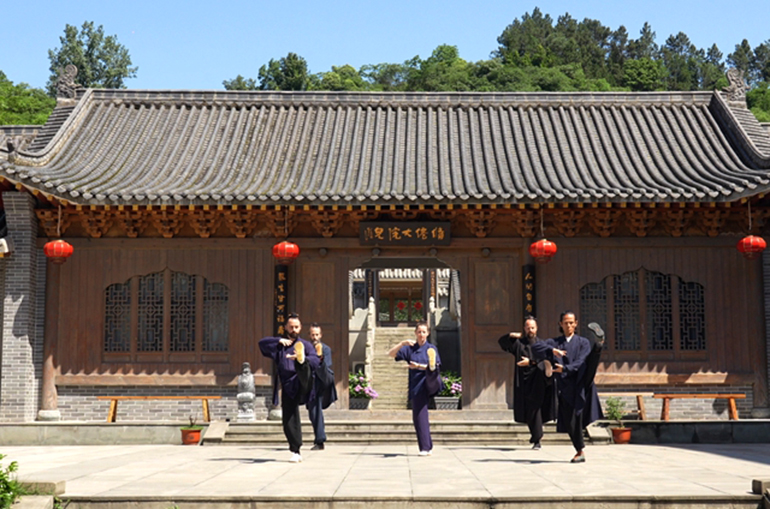
 Foreigners Beat a Path Up Wudang Mountain, Drawn by China’s Martial Arts and Cultural Heritage
(Yicai) June 24 -- The Wudang Mountains, a famed mountain range and UNESCO World Heritage site in China's central Hubei province, is attracting an increasing number of foreigners intent on learning Chinese martial arts and traditional culture.
Their ranks swelled by 70 percent last year to 22,283, according to local tourism agencies. As of June 16 this year, Wudang had received 11,825 overseas visitors, a 51 percent increase from a year earlier. More and more are choosing to stay longer to deepen their studies, rather than treating the mountain as a brief sightseeing stop.
Wudang is one of the four sacred mountains of Taoism and the birthplace of Wudang Tai Chi, a form of martial art. Its ancient buildings complex was added to the list of World Heritage Sites by the United Nations Educational, Scientific, and Cultural Organization in 1994.
The bulk of foreign visitors coming to Wudang are from the United States, Canada, France, Germany, Spain, and Italy, Yuan Shimao, head of the Wudang Taoist Kung Fu academy, told Yicai, adding that there are also substantial numbers from Russia, Poland, and Australia, while the fastest-growing numbers have come from Southeast Asia and South America in recent years.
Most are white-collar professionals, particularly engineers, healthcare workers, and mental health practitioners, who view their training at Wudang as a way to balance and improve both physical and mental well-being, Yuan said. The next-largest group consists of martial arts and yoga instructors, who seek to acquire authentic skills and formal lineage credentials so they can establish schools in their home countries.
University students, artists, and researchers in philosophy tend to focus on the aesthetic dimensions of Eastern culture and the concept of yin-yang balance underlying martial arts practice, while retired people and those recovering from chronic illnesses tend to stay for longer to heal their bodies while learning and practicing basic martial arts movements, Yuan explained.
Foreign interest in Wudang martial arts has changed a lot over the past decade, Yuan pointed out. Influenced initially by kung fu films and television, many visitors once focused on practical combat techniques, according to Yuan, whereas today the vast majority are interested in their cultural meaning, using martial arts practice as a pathway to inner calm and physical well-being.
"Foreign visitors in Wudang learn not only martial arts, but also traditional Chinese cultural arts, such as Tai Chi Qigong, guqin, and calligraphy," Gu Shining, head of the Wudang Taoist Martial Arts Wellness Academy, told Yicai. Tai Chi is the most popular and easiest to learn, he added. A guqin is an ancient seven-stringed musical instrument.
"Some visitors who love art are willing to spend time learning traditional Chinese cultural skills, such as incense and guqin culture," said Ming Yue, head of Wudang Xuanjing Fasting.
Editors: Tang Shihua, Futura Costaglione