



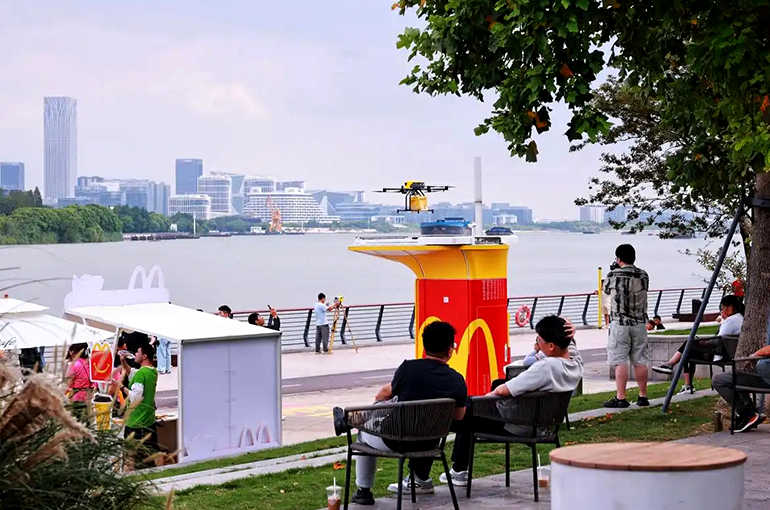
 Shanghai Becomes Meituan’s Second City With Low-Altitude Drone Delivery Network
(Yicai) Sept. 14 -- Meituan has launched a new low-altitude drone delivery network in Shanghai, making it the food delivery giant’s second in a large Chinese city after Shenzhen.
The network was officially opened in Shanghai’s West Bund, an area along the Huangpu River in the city’s central Xuhui district, on Sept. 10. The network supports deliveries from nearly 20 food and beverage chains, including McDonald’s, Amoy Teas, and MStand. Beijing-based Meituan expects the number of participating brands to exceed 40 before year-end.
Deliveries by drone are faster and more convenient than those by road, a representative of Meituan’s unmanned aerial vehicle business said at the launch ceremony. Under optimal conditions, customers can receive orders within 10 minutes, cutting waiting times and improving food freshness upon arrival, the person said.
China has made development of the low-altitude economy a national priority. Policymakers have encouraged the creation of drone logistics routes for e-commerce, medical transport, emergency response, and cold-chain delivery, while supporting the development of airports and urban air-route networks for UAVs.
Meituan first dipped its toes into the aerial delivery business in 2017 and completed its first delivery by drone to customers in Shenzhen in early 2021. Its first drone delivery network went into commercial operation in the city in May. The company piloted a single route in Shanghai’s suburban Jinshan district in December 2022.
Delivery fees are dynamically adjusted rather than fixed, a Meituan executive told Yicai. Prices may increase temporarily during periods of high demand or limited capacity caused by adverse weather and holidays, or in special locations such as parks and tourist attractions, the person said, adding that under normal circumstances, they will largely match ground delivery fees.
Meituan’s investment in low-altitude logistics in recent years reflects growing competition in last-mile food delivery, logistics expert Zhao Xiaomin told Yicai. Drone networks can improve fulfillment reliability and serve as a backup for the company, especially in extreme weather, when ground transportation is disrupted, he added.
Drones are intended to complement, not replace, ground-based human couriers, Zhao explained. Successful deployments in Shenzhen and Shanghai are expected to enable Meituan to replicate a standardized operating model across major provincial capitals nationwide, he noted.
Commercial success will depend on how effectively operators coordinate with merchants, Zhao said. Meituan is likely to expand the service to more coffee shops, hotels, and chain retailers to sharpen its competitive edge, he said.
Hurdles still remain for the low-altitude economy, including airspace regulation, compliance requirements, collision prevention, emergency-response procedures, noise management, and public-safety concerns, Zhang Yi, chief executive of iiMedia Research, told Yicai. Regulations governing these issues need further clarification, he pointed out.
According to Zhang, sustainable competitive advantage will not come from merely deploying drones first. The real challenge lies in integrating aircraft, routes, infrastructure, dispatch systems, delivery orders, and safety oversight into a viable long-term business model, he said.
Future competition will center on technological capability, operational scale, customer reach, and capital expenditure, Zhao said, adding that route density and network size will ultimately determine operational effectiveness.
Editors: Tang Shihua, Futura Costaglione