



 Investors Flock to Robotics, Smart Hardware Startup Hub in Shenzhen
(Yicai) Jan. 22 -- A narrow valley between the southern extension of Shenzhen's Yangtai and Tanglang mountains that hosts a cluster of startups focused on robots and other smart hardware has turned into a magnet for frequent investor visits since the second half of last year.
"Many investors have even moved their permanent residences to Shenzhen, with some financial advisors also relocating offices near drone giant DJI Technology," Emma, the head of hardware investments at a tech investment fund in Shanghai, told Yicai, adding that she has traveled to Shenzhen about every two weeks over the past year, sometimes even weekly.
Many financial advisors and investment firms are zeroing in on founding teams with executive experience at major Shenzhen-based hardware manufacturers as potential investment targets, because most people who leave these firms have an extreme pursuit of product performance, she noted.
Entrepreneurs who start businesses after leaving major hardware firms such as Huawei Technologies and DJI have a deeper understanding of the industry, so the growth potential and success rate of their companies are far higher than those of academic entrepreneurs, Dai Fuquan, chairman of Banshan Venture Capital, said to Yicai.
Dai is most focused on companies in the embodied intelligence supply chain, including components, dexterous hands, and robot brains, noting that he has recently started preparing to invest in a startup that makes solid-state lidar for robots.
One of the places Dai has visited most frequently to review projects over the past year is Shenzhen. "The city and its surrounding areas are home to many embodied intelligence supply chain companies, and they are more resilient than firms in other regions."
"There are many hot projects at Shenzhen's Robot Valley," Emma noted. "For the most sought-after ones, if an institution fails to get in during the first financing round, it will keep waiting to join in later rounds, with some projects having completed four to five consecutive fundraisers right after being founded, when their product was still just an idea," leading to a rapid rise in their valuations, with some projects quickly reaching a valuation of over USD100 million, she pointed out.
Hot assets include DIY manufacturing projects centered on Computer Numerical Control and three-dimensional printing, wearable hardware, and AI imaging products, she said.
"Since last year, institutions' valuation logic for hardware has changed significantly," Emma noted. "The valuations of many early-stage projects after completing their first and second financing rounds are already equivalent to what projects used to achieve at the product R&D completion stage."
In addition, institutions have a relatively high tolerance for new entrepreneurs and new entrepreneurial directions, she stressed.
"Before last September, most large funds focusing on embodied intelligence were concentrated on complete machine developers of embodied intelligence, but after that, more capital flowed to component firms," Dai pointed out. Many component makers still in the preparation stage have quickly completed seed, angel, and Series A financing rounds, he added.
"When we were investing in a dexterous hand project, we had to compete for shares with many large institutions, including well-known investment banks and state-owned platforms," Dai said. "To secure a stake, we transferred several million Chinese yuan (several hundred thousand US dollars) to the target company's account as investment earnest money before the final decision was made, in exchange for being able to get some shares in the official financing round."
Investors' interest in Shenzhen's hardware companies has grown since the second half of last year, a co-founder of a local 3D printing equipment manufacturer told Yicai. This is partly related to the strong capital market performance of several leading consumer hardware segment players after their listings, according to the person.
AI Toys, Pets Are Catching Investors' Eyes
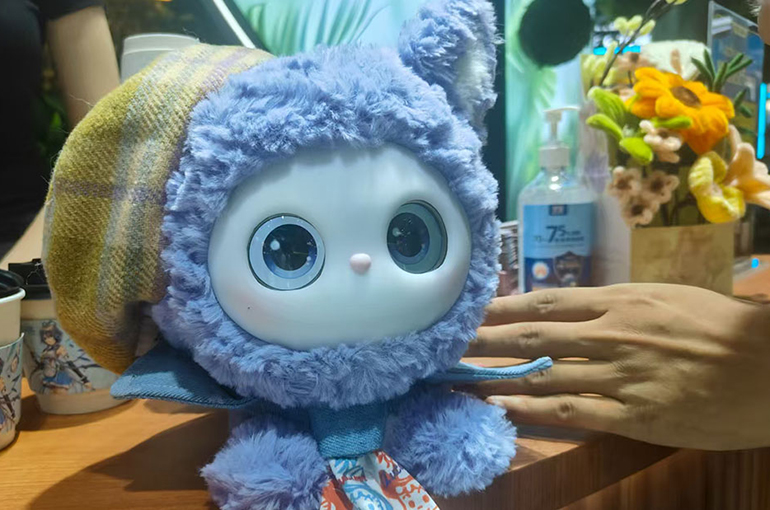
"In the Guangdong-Hong Kong-Macao Greater Bay Area alone, we know of eight to 10 entrepreneurial teams making similar products," Hu Chenhui, chief executive of artificial intelligence doll maker Meijing Technology, said to Yicai. "Around 90 percent of the various components for AI toys can be purchased around Shenzhen, with the region being home to a concentration of mechanical and electronic circuit manufacturers."
Yueran Innovation, an early player in AI toys, secured CNY200 million (USD28 million) in a Series A funding round last August from funds under CICC Capital, Sequoia China, and others. Its two product lines have sold over 300,000 units.
A supply chain manufacturer told Yicai that more AI toy makers will achieve mass production this year.
The shipment volume of downstream customers' AI pets and companion AI hardware will likely reach hundreds of thousands of units each, Xiong Gengchao, co-founder and CEO of tactile sensor startup Saigan Technology, said to Yicai, adding that the company has started small-batch deliveries to such customers.
Emma said that she is most focused on the integration of AI and imaging, companion hardware, and sports hardware in the consumer AI hardware sector. The integration of AI and imaging can also bring segmented application scenarios such as spectating, birdwatching, and stargazing, while mixing AI and sports allows exercise to be recorded and shared, and also can enable AI to coach, she pointed out.
Editors: Tang Shihua, Martin Kadiev