



 Icddr,b Starts Testing TB Diagnostic Product Developed by China's Pluslife in Bangladesh
(Yicai) July 15 -- The International Center for Diarrhoeal Disease Research, Bangladesh, a global health research institute based in Dhaka, has begun field trials for a new rapid and cost-effective swab-based molecular test for tuberculosis detection developed by Chinese firm Pluslife Technology.
The Global Fund, the world's largest funder of TB prevention and control programs, will distribute around 300,000 near point-of-care nucleic acid amplification tests for TB detection developed by Pluslife to Bangladesh, Shahriar Ahmed, Programme Coordinator of the icddr,b infectious diseases division, told Yicai. Testing will be conducted at 246 sites across the country, particularly in relatively remote areas.
The Global Fund announced earlier this month that it would prioritize the promotion of the product in Bangladesh and 12 other developing countries.
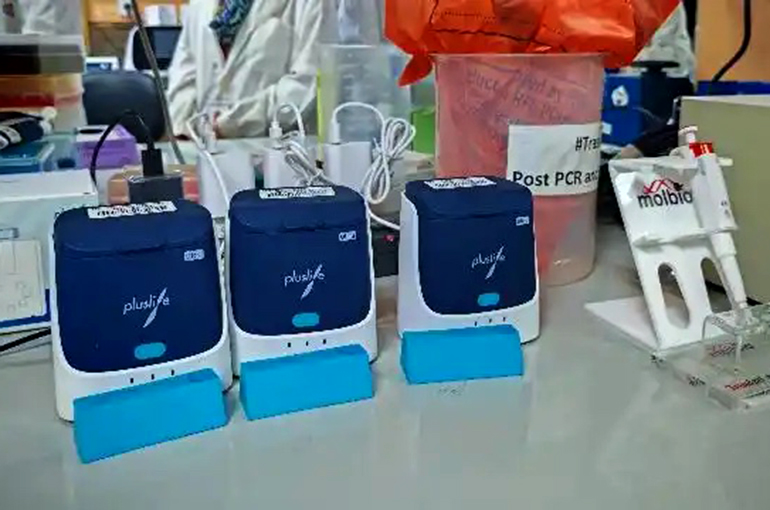
NPOC-NAATs are swab-based molecular tests for TB detection that can produce results from a primary sputum or tongue swab sample in less than one hour using instruments that can be battery-operated and do not require specialized infrastructure for use or storage, according to the World Health Organization. The only swab-based TB diagnostic product meeting the WHO standards is the one made by Pluslife.
Pluslife's TB detection test is about the size of a palm and is priced at around USD150, Yicai learned during a visit to the icddr,b laboratory in Dhaka. Moreover, it can be powered by batteries or power banks for use in areas without electricity.
"Bangladesh needs more affordable and reliable TB testing tools," Sayera Banu, Senior Scientist at the icddr,b, told Yicai. “If the new diagnostic products perform well and remain affordable, then we should consider using them.”
Sayera's team is validating the testing capabilities of Pluslife's device by conducting comparative experiments with existing testing products to assess its sensitivity and specificity.
The trials will primarily target children in Dhaka and community residents near the port and export processing zones in Chittagong, Sayera said, adding that these two groups are key focus areas for TB prevention and control efforts in Bangladesh.
Traditional TB testing methods are not only time-consuming but also require reliable cold chain logistics, stable power supply, large laboratories, and trained personnel, Yang Min, senior program officer at the Gates Foundation, who has long focused on global TB prevention and control, told Yicai. These requirements are often difficult to meet in developing countries, which has made this preventable and treatable disease one of the world's leading infectious killers, he added.
The Global Fund's procurement and promotion of Pluslife's products falls under the Early Adoption Initiative, which aims to validate, train, and test the supply chain of innovative technologies in real healthcare settings before scaling up their widespread application.
There are about 384,000 TB patients in Bangladesh, ranking eighth in the world, according to data from the WHO. Eighteen percent of them are unaware they have the disease, posing great transmission risks.
Based on WHO estimates, TB causes about 44,000 deaths a year in Bangladesh, making it the country's deadliest infectious disease. In 2024, a total of 1.2 million people worldwide died from TB, which is classified as one of the three major global epidemics along with acquired immunodeficiency syndrome and malaria.
Editors: Tang Shihua, Futura Costaglione