



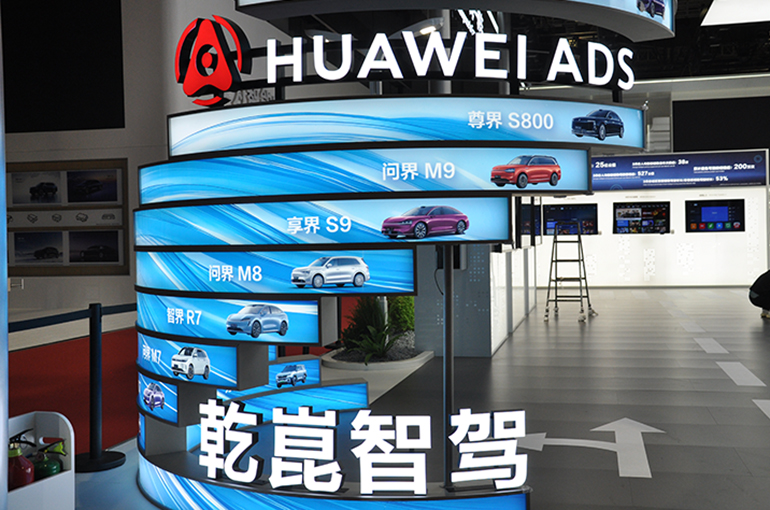
 Huawei’s Smart Driving Arm Raises Qiankun ADS Advanced Package Price, Adds Benefits
(Yicai) June 23 -- Yinwang Intelligent Technology, Huawei Technologies’ smart-driving unit, will raise the price of its flagship Qiankun Automated Driving Solution’s advanced driving package next month while also adding accident-coverage benefits, following BYD’s recent move to introduce landmark full damage coverage for urban-navigation assisted driving.
The price of the Qiankun ADS's advanced function package will increase to CNY36,000 (USD5,315) on July 1, and the one-time purchase discount of CNY4,000 (USD590) on the suggested retail price will end, the Shenzhen-based company said yesterday. Once automaker subsidies are factored in, the effective retail price will rise to CNY15,000 from CNY12,000, Yicai found.
The accident-coverage benefits added to the package cover personal injury and damage to the insured vehicle and third parties caused by accidents while the Qiankun Smart Driving ADS is being used on public roads or in legally permitted areas, the company said.
Last month, BYD Chairman and President Wang Chuanfu announced that the automaker will provide liability coverage for the Urban Navigate on Autopilot feature of its DiPilot driver assistance system in China by paying all repair, compensation, and related costs that should be borne by the vehicle owner, with no upper limit.
BYD's guarantees only apply to its DiPilot 600 and DiPilot 300 systems. Vehicles equipped with the DiPilot 100 system need to pay CNY12,000 for the guarantees. The upgrade cost was increased from CNY9,900.
Yinwang, which is 80 percent owned by Huawei, and BYD said the price hikes were due to surging global memory costs.
The price of the high-end auto-grade Double Data Rate 5 has soared more than 300 percent. At the same time, demand from artificial intelligence businesses for high-computing-power chips is absorbing more and more manufacturing capacity that had been allocated to auto-grade chips, according to TrendForce. Chipmakers are also shifting capacity toward more profitable High Bandwidth Memory products.
TrendForce expects server demand to account for 59 percent of global dynamic random access memory production capacity by 2028, leaving the auto sector at the lower end of the supply chain, dependent on high-priced chips bought in the spot market. In that scenario, the entire industry would enter “shrinkflation," TrendForce said.
Editor: Martin Kadiev