




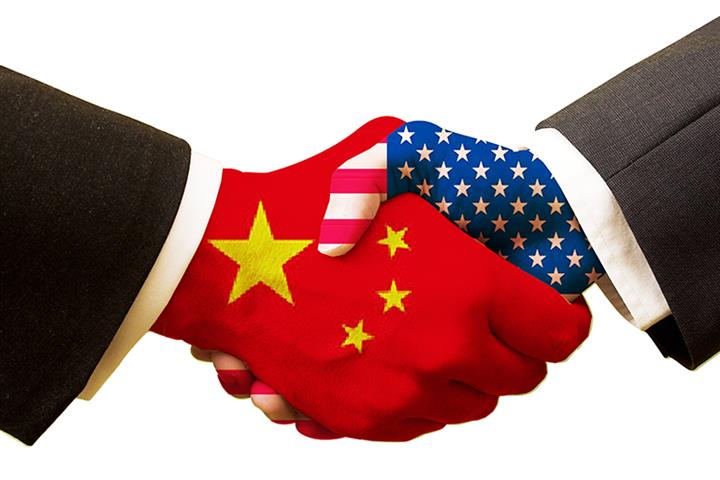
 Don’t Expect Any Breakthrough in China-US Trade Talks
(Yicai Global) Feb. 16 -- It has been widely reported in the mainstream media that China failed to live up to the demands of what is described as the “US-China phase one trade agreement”. Signed in January 2020 as a product of Trump’s trade war against the country, the agreement stipulated that Beijing purchase over USD200 billion in agricultural products from the United States per annum. However, Beijing reportedly only purchased USD288.8 billion across the two-year period, amounting to only 57% of the total. The outcome inevitably led to criticism from the Biden administration, who urged China to live up to their commitments and, as according to a Bloomberg article vowed to hold Beijing “accountable”.
If it wasn’t clear already, it is a political reality of the day that the Trump era tariffs on Chinese exports to the United States are here to stay, and there is minimal space to remove them. Similar to Biden’s position on China as a whole, with American foreign policy lopsided towards hostility, and protectionism continuing to rule the day through the “America First” train of thought, any effort at dialogue is ultimately offset by the US making one-sided and unreasonable demands with little willingness to make any concessions, even if Beijing is publicly cordial concerning such talks. As the tariffs have likewise failed to make a dent in China’s trade to the US, Beijing likewise sees little incentive to fix it.
The “Sacred-Cow” of Tariffs
From 2018-2019, the Trump administration placed hundreds of billions worth of tariffs on Chinese exports to the United States of which marked the first phase of unleashing the Anti-China agenda in Washington. In putting them in place, the Trump administration accused Beijing of pursuing “unfair” practices which had subsequently undermined American jobs and prosperity, using racial dog whistle terminology such as “stealing” and “cheating”. It was claimed that tariffs would encourage jobs to come back to the US, or at least on the strategic level hurt China by facilitating supply chain shifts, forcing China to give the United States preferential concessions in access to its domestic markets. Numerous business groups, CEO’s and other representative organizations have long criticized the tariffs, but they have been repeatedly ignored.
Unsurprisingly, the tariffs failed to be a game changer for the US. The pandemic which came soon after was a big factor, consolidating the reality that China was the only stable supply chain in the world capable of meeting mass demand for medical equipment, covid-19 testing kits, masks and other provisions. The US economic recovery also facilitated a consumer boom of which China was the primary benefactor of. However, the sustaining of the tariffs ultimately contributed to a record surge in inflation which now amounts to 7.5% year on year. Despite more criticism mounting, including Senators also appealing to extend the range of “exemptions”- this has also been ignored.
The tariffs are in effect a “sacred cow” of US politics. Even though they do not work in practice, they symbolize the devotion to “protecting American jobs” as well as “confrontation” with China. Thus, to attempt to backtrack on them, with even Treasury Secretary Janet Yellen being a vocal opponent of them, is paramount to political suicide as Republicans are likely to accuse the White House of effectively appeasing China in an environment whereby Trump has transformed it to quasi-adversary status. Therefore, against all economic logic the Tariffs are untouchable save huge concessions are delivered, which has transformed trade talks between the US and China to the White House making one sided demands and pitching complaints to the domestic audience about “unfair economic practices”.
Moving forwards
Unsurprisingly, the Trump “phase one” trade deal did not work because its demands were simply ludicrous and not weighted on market dynamics. China cannot import more agricultural products than it actually needs, and the media have not contemplated at all that consumer demand would have inevitably fell during the initial pandemic phase too. This poses the question, what happens next? Bloomberg talks about US retaliation in the form of more tariffs, but this would be an act of economic self-destruction in a country that is already suffering burgeoning inflation, this makes escalation unlikely. There is a reasonable probability that the Biden administration may seek to deliver a “win for American jobs” prior to the Mid-term elections, but it remains unlikely that China would be willing to deliver the kind of concessions willing to make that politically feasible when the mood in Beijing is hardening against the United States, seeing Washington as acting in bad faith and being simply unreasonable.
Whilst Beijing is focusing on opening up its markets more to numerous other countries, it harbours a “if it isn’t broke, don’t fix it” attitude towards its economic system, and plainly sees the scale of changes the US is demanding as a non-starter, even if it continues to oppose the tariffs. After all, China achieved a USD676 billion trade surplus in the year of 2021. It is not desperate or in a hurry for the US to change its policy. Likewise, if the US inflation situation continues to deteriorate, Beijing may also sense it has the upper hand. Whilst China sought to appease a very unstable Donald Trump, it senses Biden is not as prone to self-destructive behaviour and the willingness to create a crisis if he does not get what he wants.
But in summary, the US-China trade situation is stuck between a rock and a hard place. As the dogma of protectionism and opposition to China continue to rule the day in Washington D.C. Beijing similarly has absolutely no reason to capitulate, meaning progress is unlikely. The trade war is now effectively a frozen war.






