



 Five Resources Will Shape Global Competition, Unitree CEO Says
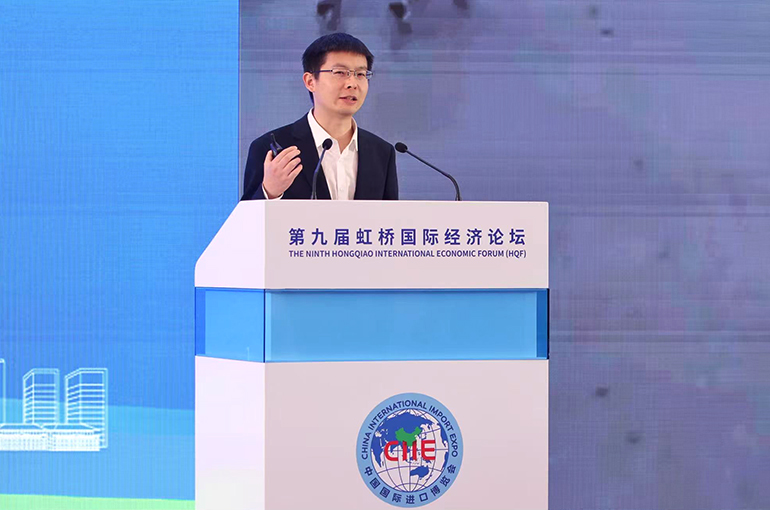
(Yicai) Nov. 6 -- Five resources are becoming the most critical strategic assets in global competition, according to Wang Xingxing, founder of Chinese humanoid robot maker Unitree Robotics.
They are data, computing power, chip production capacity, energy, and minerals, Wang told a robotics and embodied artificial intelligence sub-forum at the ninth Hongqiao International Economic Forum held in Shanghai yesterday.
“These five resource categories will constitute the world's most essential assets in the future,” he said. Competition in the sphere of computing power will be "extremely fierce," he noted.
AI competition is extending beyond models and algorithms to encompass the foundational resources that underpin the technology’s development, he said.
Turning to technological developments in humanoid robotics and embodied AI, Wang said the key challenge is no longer simply whether AI models can understand instructions, but whether they can translate that understanding into precise physical movements.
For example, the world's leading multimodal models can already achieve success rates near 100 percent when instructing robots to grasp relatively large objects, but that drops when the same models are used for more delicate operations, such as picking up mechanical parts, he noted.
The underlying issue is that multimodal models have yet to achieve sufficient alignment between their inputs and outputs and the physical world, Wang pointed out. Even when a model understands what a task requires, translating that into a robot's movements can still produce errors of several millimeters, he said, adding that in precision-dependent uses such as industrial manufacturing, even such small deviations can cause operational failure.
Once this issue is resolved, relatively few major technical obstacles will remain to prevent embodied AI models from being used in real-world settings, Wang said.
The remaining challenges will mainly concern engineering development and commercial deployment, he said, adding that he expects this technological bottleneck to be substantially overcome within the next one to two years.
Editors: Tang Shihua, Martin Kadiev