



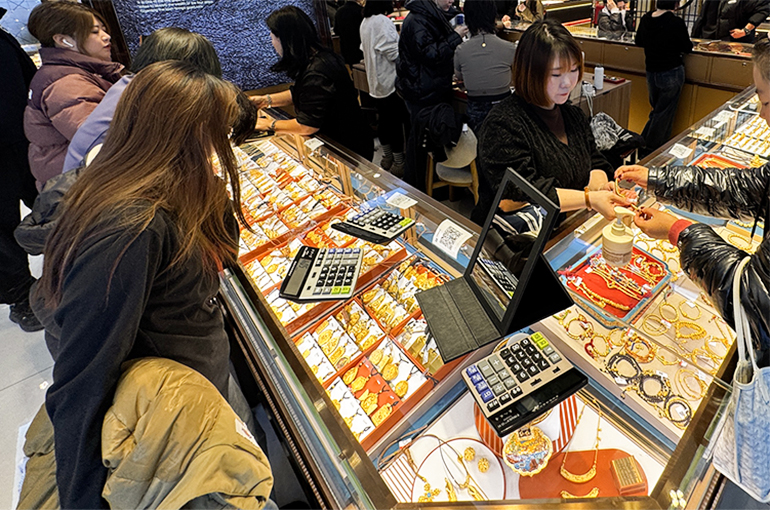
 Chinese Jewelry Stores Hike Prices, Banks Issue Risk Warnings as Gold Jumps Amid Middle East Conflict
(Yicai) March 2 -- Jewelry stores in China are raising their gold product prices and Chinese banks are tightening risk controls around their retail gold businesses through warnings and stricter access rules, as the price of the precious metal jumps amid an escalating Middle East conflict.
Gold prices at most jewelry retailers across China climbed above CNY1,600 (USD233) per gram on Feb. 28, the day the United States and Israel launched airstrikes on Iran, marking an increase of more than CNY30 (USD4.40) on the previous day. Laopu Gold changed its gold prices that day for the first time this year, raising them by between 20 percent and 30 percent.
Spot gold in London hovered around USD5,180 per ounce on Feb. 27 before surging late in the session to close above USD5,278, according to data provider Wind Information. The rally extended into the next trading session, opening about 2.2 percent higher at USD5,393 today.
Supplies of investment-grade gold bars in China have tightened. All “Ruyi” gold bars, a bullion line produced by Industrial and Commercial Bank of China, sold out yesterday, the apps of major state-owned lenders show.
In response to short-term volatility risks, several banks issued risk alerts. China Zheshang Bank said in a Feb. 28 statement that volatility in the gold price has intensified recently due to international geopolitical tensions and economic policies, raising the overall risk level for investors.
The bank added that if sharp and abnormal price swings, severe liquidity shortages, and a marked decline in transaction capacity continue, it may temporarily suspend trading in its Wealth Gold Accumulation product.
Meanwhile, other lenders have reclassified gold accumulation as a medium-risk investment. China Merchants Bank, for instance, now assigns its personal gold account business an R3 rating, indicating medium risk, and requires individual clients to undergo a risk-tolerance check before opening an account.
Gold’s near-term trajectory will largely hinge on how the conflict in the Middle East evolves, including its scope and intensity, according to sources in the industry. Over the longer term, the impact of geopolitical events is expected to diminish gradually, allowing the market to return to more rational trading.
Future price movements will depend heavily on the scale of Iran’s counterattack and whether the conflict spreads further, said Wang Weimang, investment manager in Zhonghui Futures’ asset management department.
If hostilities expand to Lebanon or the Red Sea region, disrupting shipping routes and tightening energy supplies, gold could soar, supported by both safe-haven demand and rising inflation expectations, he added.
Editor: Futura Costaglione