


 Chinese Firms Going Global Should Adopt New Playbook Amid AI Boom, Geopolitical Shifts, Execs Say
(Yicai) Oct. 23 -- Chinese companies going global should implement new strategies as geopolitical rivalries raise the cost of competing as key players rather than hidden suppliers, and artificial intelligence reshapes both the global economy and compliance risk, experts said at a roundtable talk during Yicai Global's 10th anniversary ceremony.
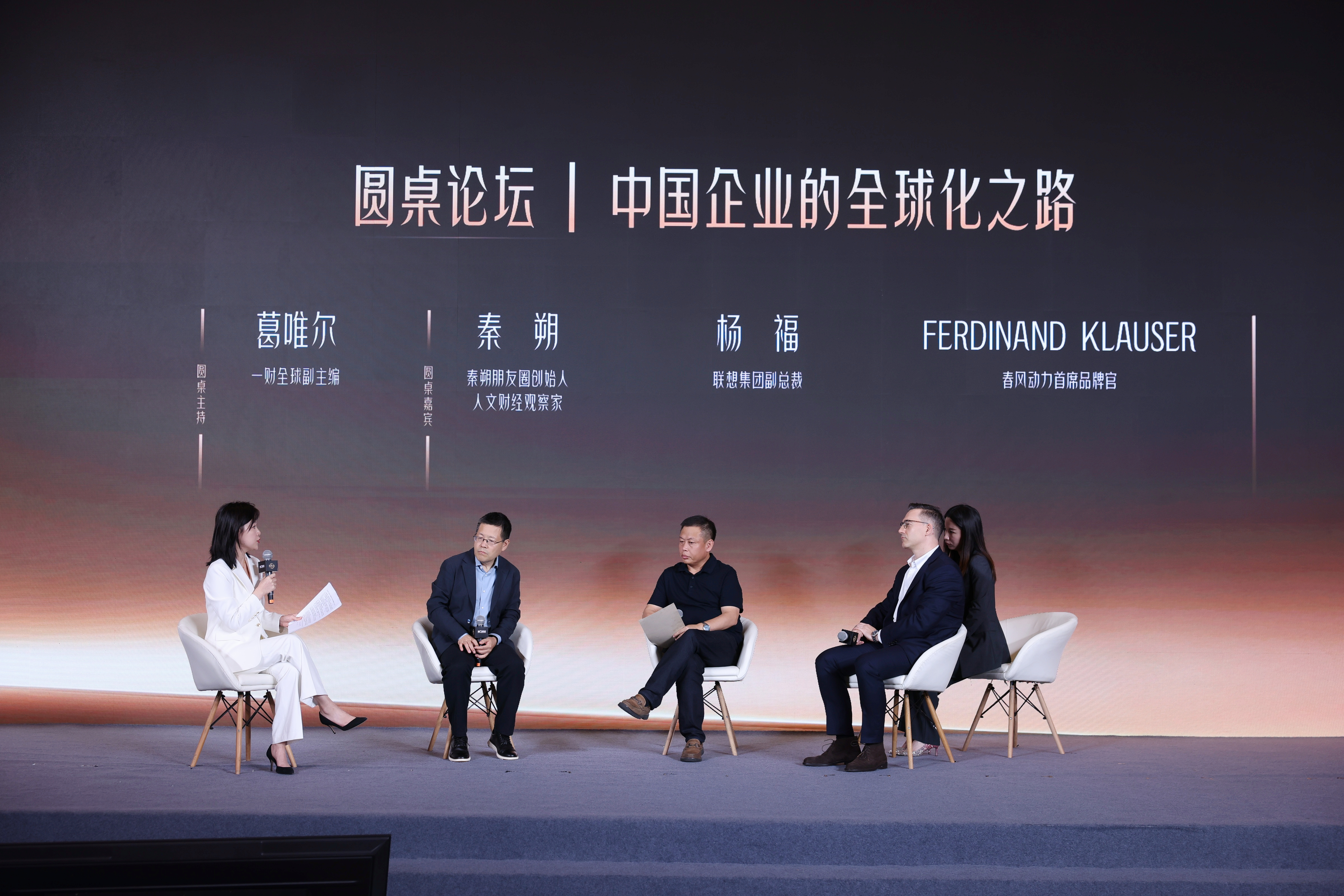
Economic and financial observer Qin Shuo, Lenovo Group's Vice President Yang Fu, and CFMOTO's Chief Brand Officer Ferdinand Klauser discussed how Chinese firms can move from exporting production to exporting brands, systems, and values at a panel titled 'Understanding the Globalization of Chinese Enterprises Through International Communication,' moderated by Ge Weier, Deputy Chief Editor of global Markets at Yicai.
Structural Pain Amid Expanding Volume
Despite de-globalization talks, hard data shows that the overall globalization scale continues to grow, Qin said. If you look at global trade, foreign direct investment, freight, and travel, the total volume is still expanding," he noted, citing China's industrial advantages as grounds for optimism.
What makes this decade difficult is a structural shift, according to Qin. China-United States relations, which were once defined by complementarity, are now dominated by competition, leaving less room for cooperation.
The underlying logic of Chinese outbound expansion has also changed. "In the past, globalization pulled China along," Qin noted. In the past, international capital and brands used China's supply chains and low costs to manufacture under their own labels, while Chinese merchants used rock-bottom costs to penetrate niche global markets, following a pattern exemplified by the Yiwu small-commodity model.
But over the past decade or so, China has shifted toward brand globalization, which means that the country's own industrial strengths are beginning to lead globalization," he explained. Coming from behind, Chinese firms are now challenging foreign brands to compete as market principals, creating more friction and more pushback.
Reshaping Supply Chains and Brands
As priorities shift from pure efficiency to de-risking, balancing global scale with local presence has become a daily test for multinational companies, Yang said. Lenovo's footprint adjustments date back to its 2004 acquisition of IBM's personal computer business, but accelerated after 2018.
Under its 'Glocal,' or 'China + N,' model, Lenovo keeps its manufacturing base camp in China, with major hubs in Wuhan, Hefei, Tianjin, and Shenzhen accounting for about 80 percent of its total capacity, while running factories in more than 30 countries, Yang noted, adding that the company has been building its own factories since 2012.
Staying close to end-users is equally critical for CFMOTO, a 37-year-old Chinese motorcycle giant. The company is going all out to shed the cost-effective label attached to Chinese manufacturers and build a premium brand in Western markets, where motorcycles and all-terrain vehicles are tied to lifestyle and enthusiast culture.
Present in over 100 countries through more than 9,000 dealerships, CFMOTO sees globalization as not just a matter of where it sells but also how it operates, Klauser said. The firm has factories in China, Thailand, and Mexico and research and development centers in the US and Europe.
To build what Klauser called "brand desire," CFMOTO has paired motorsport credentials -- a 2024 Moto3 triple crown, the 2026 Moto3 title, and a sweep at the Red Bull Romaniacs enduro rally -- with firsthand outreach to close a perception gap abroad.
"In China, we're surrounded by payment technology and innovation, so it's easy to forget that this doesn't fully translate," said Klauser, who has lived in China for a decade.
Earlier this month, CFMOTO hosted 100 journalists from 29 countries at its Hangzhou headquarters. "We have to change our understanding of what Chinese companies and Chinese brands are," he noted.
The AI Factor
Beyond supply chains and branding, AI is emerging as the largest variable reshaping both the global economy and corporate globalization.
AI dominated nearly every high-level discussion at the recent World Bank and International Monetary Fund annual meetings in Bangkok, from the IMF's Managing Director Kristalina Georgieva questioning Federal Reserve Chairman Kevin Warsh on whether the US' AI investment is overheating, to the Bank of Canada's Governor Tiff Macklem and DHL's Chief Executive Tobias Meyer sharing the stage with Anthropic's co-founder Jack Clark, Ge said.
AI is a double-edged sword for Chinese companies going abroad, Qin said. It lowers the barrier to researching overseas markets and smooths headquarters support -- a sharp contrast to the trial-and-error approach of the past -- but it cannot resolve local regulations or erase origin-country bias on its own. Fragmented global AI governance could become a new barrier, he noted, adding that China's strength in AI models should prove a net positive if handled well.
Lenovo is likely to achieve its target of USD100 billion in annual revenue, which CEO Yang Yuanqing set to be reached within two years, already this year, as the company's AI server infrastructure pipeline jumped to USD80 billion this quarter from USD54.7 billion the previous one, Yang Fu said.
Behind that growth lies an uncompromising approach to compliance, which Yang Fu called "Lenovo's lifeline." Most controversies involving Chinese firms abroad trace back to compliance failures. With about 60 percent of its nearly USD100 billion revenue coming from B2B clients—including Fortune Global 500 companies—and government entities, regulatory compliance is absolutely critical.
"There are no shortcuts, Yang Fu pointed out. "We strictly follow local laws and regulations across all 180-plus markets we operate in, always adhering to the highest standard rather than the lowest." He called this approach the "insurance" that has kept Lenovo resilient through geopolitical turbulence.
Klauser agreed with Yang Fu. "We have a very physical product," he explained. “That means safety is absolutely the priority, and any application of innovation technology needs to be done very carefully and responsibly.”
Charting the Next Decade for Global Co-Creation
The three executives all agreed that Chinese enterprises must shed old mindsets to become truly global players. Western, Japanese, and South Korean multinationals carried strong soft power when they expanded decades ago, Qin said. Chinese smart-hardware brands such as Anker Innovation, DJI Technology, and Insta360 now hold top market shares and command premium prices in Japan, but skepticism over subsidies, along with concerns about domestic involution-style competition spilling overseas, remains a headwind.
"Chinese companies must shift from overemphasizing their Chinese attributes to embracing the identity of a new-generation global company," Qing pointed out. “If you go abroad projecting the image of a conqueror, it simply won't work. You must answer what value you bring to the host country and its stakeholders.”
"Going global in today's geopolitical climate requires replacing winner-takes-all with genuine win-win cooperation," Yang Fu said. Lenovo positions itself as a "connector of global resources," which it credits for keeping supply-chain partners on side despite US-China tech tensions, he added.
The next step is using AI to move from hardware to solutions and services, as it did by turning a FIFA World Cup AI tech partnership into a vertical sports offering whose pipeline passed USD100 million in two months, according to Yang Fu.
Klauser summed up the shift required. "In the future, we don't want to be measured just within the group of Chinese companies," he noted. “Our origin is Chinese, but our competitiveness and ambition are global.”
Editor: Futura Costaglione