



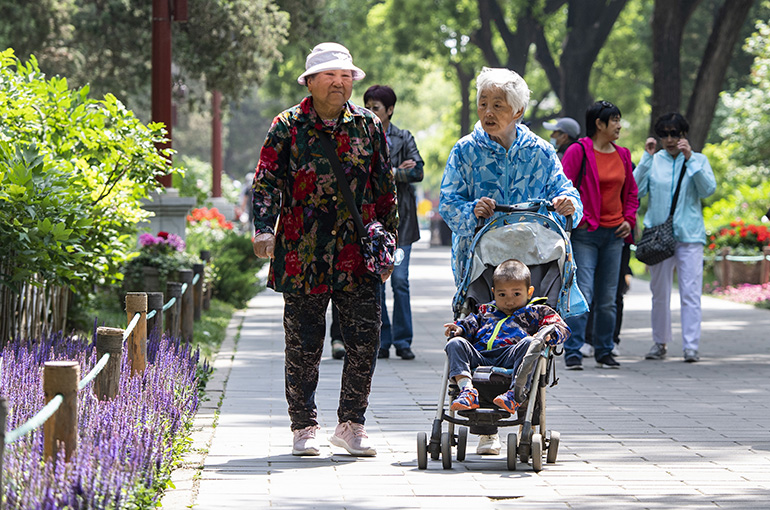
 China’s Livelihood Policies in 15th Five-Year Plan to Focus on Elderly, Children
(Yicai) Nov. 11 -- The livelihood policies China will include in its 15th Five-Year Plan for social and economic development will be centered around education, healthcare, and services for the elderly and children.
China will optimize the allocation of resources for preschool and compulsory education and raise the number of ordinary high school and higher education degrees via multiple channels, Huang Weiru, deputy director of the Department of Social Development of the National Development and Reform Commission, said at a press conference yesterday.
The number of students attending Chinese kindergartens, primary schools, and junior high schools dropped by nearly 17 million during the 14th Five-Year Plan period (2021-2025), Huang noted, adding that the number of senior high school and higher education students continues to grow instead.
Universities and colleges under China’s Double First-Class Initiative have already expanded undergraduate enrollment by 24,000 students this year, with new admissions mainly opened in majors urgently needed by national strategies, according to Huang.
On healthcare, the NDRC pledged to implement initiatives to strengthen community-level medical and health services, focusing on supporting the construction of shared centers for county-level electrocardiogram diagnosis, examination and testing, imaging, and drugs, and improving the service level of key township healthcare centers.
China has spent more than CNY20 billion (USD3 billion) to renovate 20,000 wards for four or more patients into wards for two to three patients to improve the hospitalization environment.
The nation will continue to promote the development of community-level medical capacity and the renovation of hospital wards, and strengthen the connection between treatment in tertiary hospitals, rehabilitation in secondary hospitals, and community-level and home-based care services.
Regarding care services for the elderly and children, the NDRC allocated CNY14 billion in central government budgetary investment to support the construction of elderly care and childcare facilities, setting up over 100,000 new nursing beds for elderly care and over 30,000 new childcare spaces.
China will increase the proportion of nursing beds in elderly care institutions to 73 percent, build comprehensive childcare service centers at all prefecture-level administrative regions, and develop integrated childcare services.
Moreover, China will improve the pricing mechanism for inclusive services, cut institutions’ operating costs with government subsidies and other measures, guide prices for basic services, and implement market-regulated policies for personalized non-basic services, said Zhang Luqin, deputy director of the NDRC pricing department.
For example, after related policies took effect, the supply of inclusive childcare spaces nationwide jumped nearly 20 percent, and the average price of inclusive childcare services fell about 13 percent.
The 15th Five-Year Plan is a window of opportunity for systematically reshaping population policies, where China focuses on services for the elderly and children to accelerate the establishment of a high-quality population development support system, improve the childcare service system and elderly care services, and strengthen comprehensive supervision of elderly care services to support long-term balanced population development, Zhang Jun, chief economist of China Galaxy Securities, told Yicai.
Editor: Futura Costaglione