



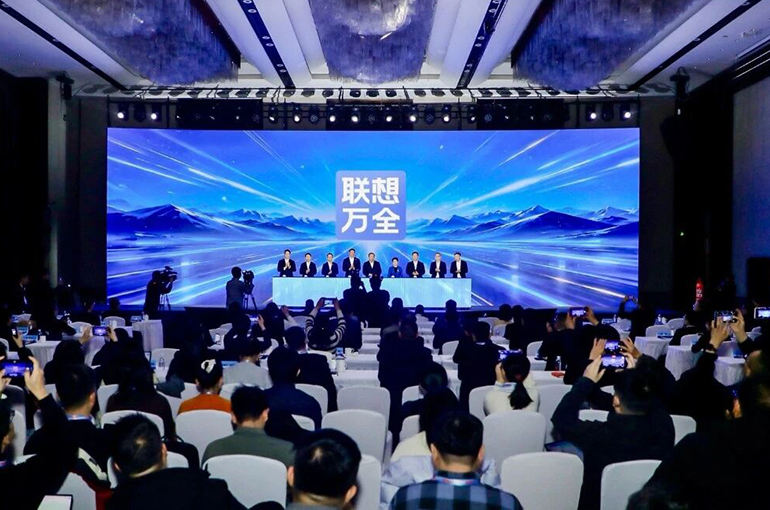
 China's Lenovo to Build First Prototype Token Plant in Zhangjiakou
(Yicai) Nov. 11 -- Lenovo Group rolled out its hybrid token factory initiative in Zhangjiakou, a city bordering Beijing and rich in new energy resources, with the world's largest personal computer maker signing an agreement with the local government to build its first prototype token plant.
Under Lenovo's plan unveiled yesterday, the initial phase will include a 15,000-petaflop heterogeneous computing cluster and a roughly 100-megawatt smart computing center, with annual token output exceeding two quadrillion tokens. Its peak token output during initial operation will likely top 200 million tokens per second.
Unlike traditional data centers, which focus largely on rack count and computing scale, token factories track token output, generation speed, and comprehensive costs as operational metrics. The business model remains in the exploration stage.
Lenovo is exploring a new computing service model in which, instead of merely selling server cabinets and computing resources, it converts computing power into metered, deliverable token services, Senior Vice President Dai Wei, who is also general manager of China Solutions and Services Group, told Yicai. "Raw computing power does not inherently deliver real value."
The core of the token factory business model is to orchestrate resources across different chips, models, public clouds, and private clouds to cut idle computing capacity and unnecessary high-cost calls, noted Liu Jun, executive VP of Lenovo and president of Lenovo China.
The token factory model is not simply a traditional data center with a revised billing method, Dai said, noting that the core challenge is lowering client costs while sustaining operator profitability. An operator's profitability hinges on token production per second, computing utilization rates, client pricing levels, equipment depreciation, power costs, and the stability of long-term contracts, he pointed out.
At this stage, it is uncommon for a single company to bear the construction and operating expenses of a hybrid token factory alone, he said. Beyond large enterprises, cloud vendor and telecom carrier clients, the bigger growth potential for token plants may lie within industrial clusters, where aggregated inference workloads from multiple firms lift infrastructure utilization, he added.
The Zhangjiakou prototype factory has dual missions: to meet Lenovo's growing artificial intelligence application demands and to validate the construction, operation, and cost-optimization framework for such facilities, serving as a replicable template for deployment in other industrial regions, Dai stressed.
Lenovo plans to set up a token factory in Hunan province for film and television content production, aiming to cut production costs in half, shorten production cycles by 60 percent, and deliver more than 1,200 hours of content per month for local clients, he pointed out. In addition, it plans to develop token plant use cases tailored to local industrial strengths in other regions, covering smart manufacturing, education, and computing power export clients, he noted.
"The capital value of the token economy ultimately needs validation from two sets of books: one measuring client productivity gains and one tracking supplier profitability," Ying Ying, chief analyst covering the computer sector at Citic Securities, said to Yicai. "Only when both add up can the industry sustain growth, and corporate valuations gain solid underpinnings."
About 180 kilometers northwest of Beijing, Zhangjiakou is a key hub within the Beijing-Tianjin-Hebei computing cluster under China's national East-to-West Computing Transfer project. It has drawn major players including Lenovo, Alibaba Group Holding, and Tencent Holdings, along with a host of data center operators. It has 55 operational computing centers with a total smart computing capacity of 318,000 P (16-bit floating-point).
Zhangjiakou is also a national renewable energy demonstration zone with abundant wind and solar power resources. Its installed renewable energy capacity surpasses 45 gigawatts, with annual power generation exceeding 70 billion kilowatt-hours.
Editors: Tang Shihua, Martin Kadiev