



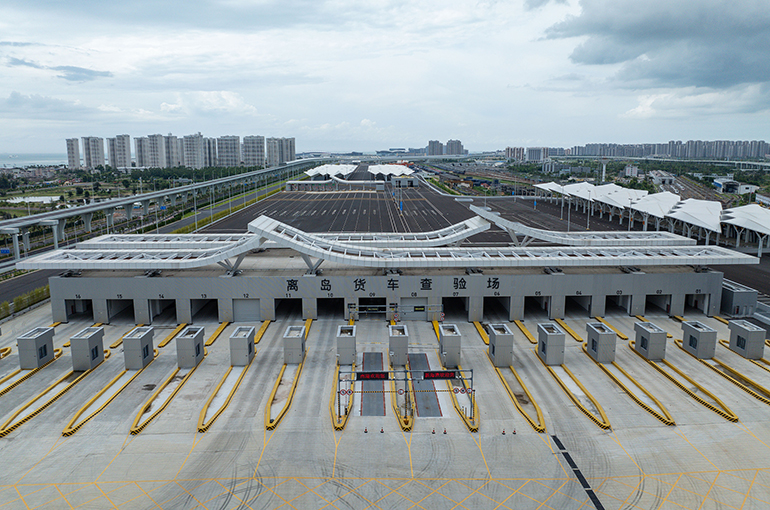
 Hainan Island Gets Ready to Become China’s First Free Trade Port on Dec. 18
(Yicai) Dec. 12 -- Hainan province is counting down to the launch of its full customs closure on Dec. 18, when China’s southernmost province will begin island-wide independent customs operations under the Hainan Free Trade Port and roll out a raft of tax incentives and preferential policies to spur trade and investment.
There are just six days to go before Hainan turns into a special zone under China’s customs supervision, which is very different from a typical free trade zone. Once the full customs closure is in place, the island will implement a series of initiatives allowing goods and people to move freely between Hainan and other countries and regions, while also precisely managing the liberalization measures between the Hainan FTP and the mainland.
Managing risk is key to the success of the free trade port. The province has made thorough preparations against major risks such as smuggling, taxation and environmental protection, from regulatory systems to operational mechanisms, said Tan Jian, director of the Pressure Testing and Risk Control Division at the Hainan Provincial Committee’s Deepening Reform Office.
Hainan completed the third round of pre-closure stress tests between Dec. 2 and Dec. 10, Tan said. Coordination between ports, customs, and public security departments was carried out smoothly and all facilities, equipment and system platforms performed stably.
Policy documents and supporting institutional files for the customs closure, including the list of taxable items, the prohibited and restricted goods list as well as the tax exemption policy for processed goods with value-added domestic sales have been published.
Once the full-island customs closure is in place, Hainan’s zero-tariff policy for imported goods will become much broader. Specifically, the proportion of imported commodities eligible for zero tariffs will jump to about 74 percent from 21 percent, involving around 6,000 tax items. This adjustment means many more types of imports will enjoy exemptions from import duties, import value-added tax and consumption tax.
The tax exemption policy for processed goods with value-added domestic sales allows goods produced by encouraged industries in Hainan to be exempt from import tariffs when sold to the mainland, as long as the imported components account for at least 30 percent of its added value.
For example, a batch of Argentine beef worth around CNY356,000 (USD50,500) would normally be subject to almost CNY43,000 (USD6,000) in duties at a 12 percent tax rate if imported directly to mainland China. Under Hainan Free Trade Port rules, if the beef is processed into jerky in Hainan and sold to the mainland for CNY500,000, the CNY43,000 tariff can be waived because its processing value-added rate is greater than 30 percent.
The tax exemption policy for processed goods was first introduced in July 2021 and has been refined over the past four years. As of October, Hainan had approved 129 companies for the pilot program, with processed domestic sales reaching around CNY11.1 billion (USD1.5 billion), resulting in roughly CNY860 million (USD121.8 million) of tariff exemptions. After the full customs closure, this policy will expand from pilot programs in some industries and areas within the island to include the whole island.
Editor: Kim Taylor