



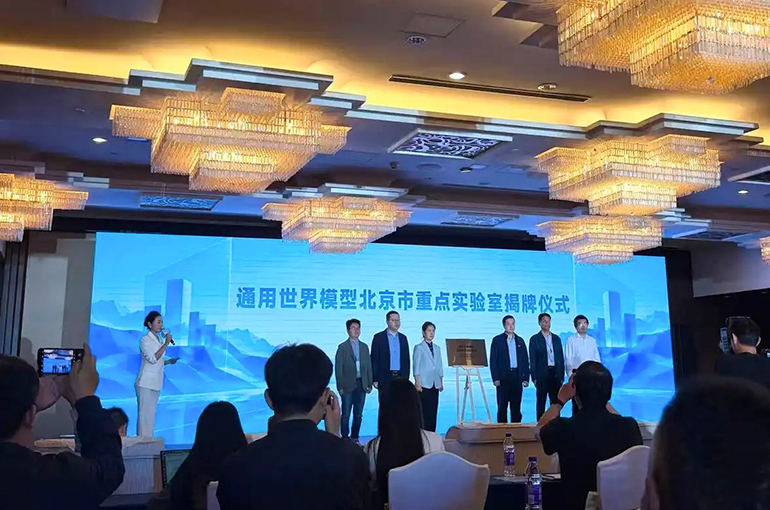
 China’s GigaAI Opens General World Model Lab in Beijing
(Yicai) Oct. 12 -- Chinese artificial intelligence startup GigaAI has opened its General World Model Beijing Key Laboratory, the first laboratory of its kind recognized by a provincial government in China.
Artificial general intelligence cannot be limited to language intelligence, Huang Guan, founder and chief executive officer of GigaAI, said in an interview with Yicai during the lab’s opening ceremony at the 2026 World Model Summit Forum yesterday. AGI also needs to understand, generate, predict, and act in physical three-dimensional space, abilities that depend on breakthroughs in General World Models, he noted.
A General World Model is a fundamental AI model that can understand, predict, and simulate the physical world, and aims to enable AI to develop 3D environmental representations, predict action-driven environmental changes, and support AI agent applications, including in robots, autonomous driving, and content creation that interact with the physical world.
Previously, Beijing-based GigaAI proposed a Level-1 to 5 tiered system for General World Models. The L1 tier can generate visually lifelike general videos based on input and can be used to produce AI short dramas and game content; L2 can generate efficient and reasonable general execution actions, transforming environmental understanding into executable action sequences, and can be used in autonomous driving and embodied robot control; L3 can generate geometrically accurate general spatial worlds and create 3D environments that can be located, measured, and navigated; L4 can construct a world that conforms to physical laws and predict the physical causes and effects of actions; wihle L5 aims is to understand the physical world in an open environment and achieve continuous interaction and dynamic evolution of multi-agent systems.
“World Models are relatively mature at L1, and have seen the light at L2, though have not achieved any breakthrough at L2,” Huang noted. They generally lag behind language models by three to four years and first need to scale up to at least one million hours of action data to take another step forward, he said.
A World Model predicts how things evolve under specific actions through computation, including cross-modal, cross-temporal, and cross-scenario information, said Lu Jiwen, deputy head of Tsinghua University’s automation department, who is the new lab’s academic committee director. The “general cognitive model” concepts will be a higher-level stage in the development of physical AI, capable of understanding states, predicting changes, and judging consequences, he added.
World Models have higher requirements on computing than language models, noted Lin Yonghua, deputy director and chief engineer of the Beijing Academy of AI. “World Models have multiple spatial dimensions and involve the generation of multiple pieces of information, which determines that the computational complexity of their training and inference is much higher than that of language models.”
Demand for World Model computing is no longer just an increase in the number of tokens, but a gradual upgrade in goals, dimensions, and constraints, Lin pointed out.
Zhu Zheng, co-founder and chief scientist of GigaAI, will serve as director of the General World Model Beijing Key Laboratory.
Editors: Tang Shihua, Martin Kadiev