



 China’s Foreign Trade Hits Record High in First Half on AI Boom, Industrial Momentum
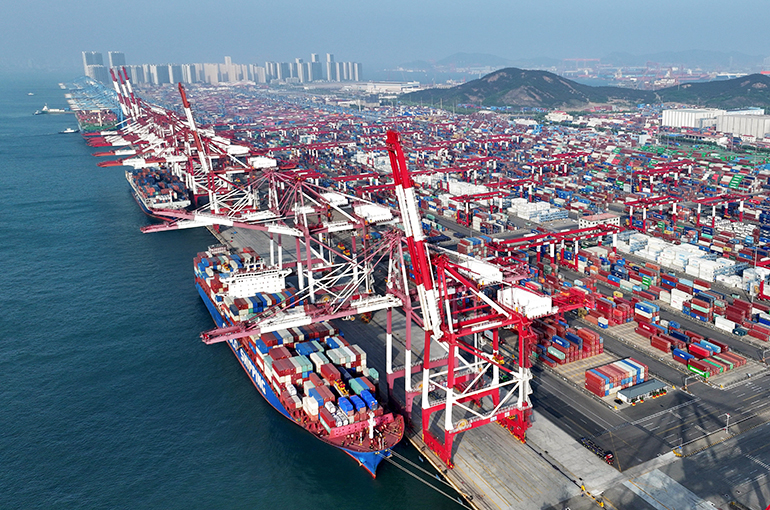
(Yicai) July 14 -- China's trade in goods soared to USD3.67 trillion in the first six months, setting an all-time high for the period, supported by a recovery in external demand that was driven by strong appetite for artificial intelligence-related products, while robust industrial production boosted imports of raw materials and other goods.
The value of China’s imports and exports surged 21.2 percent in the six months ended June 30 from a year ago to USD3.67 trillion, according to data released today by the General Administration of Customs. Of this, exports soared 17.6 percent from a year earlier to USD2.12 trillion, while imports jumped 26.6 percent to USD1.55 trillion.
Measured in Chinese yuan, total trade rose 16.9 percent year on year to CNY25.47 trillion (USD3.7 trillion), of which exports increased 13.4 percent to CNY14.73 trillion and imports soared 22.1 percent to CNY10.74 trillion.
The rapid development of the AI industry drove the imports and exports of computing hardware, including electronic components and computer parts, up 56.6 percent from a year earlier to CNY5.13 trillion (USD756.7 million), GAAC Deputy Head Wang Jun said at a press briefing.
AI-related products contributed 6.9 percentage points to export growth during the period. Over 10,000 intelligent bionic robots, which integrate AI technologies, were shipped to more than 90 countries and regions, he added.
The strong export performance was the result of a combination of factors, Yang Chang, chief expert at the Shanghai University of Finance and Economics’ Institute of Public Policy and Governance, told Yicai.
Major overseas markets have entered a new inventory restocking cycle, while sustained demand for AI-related products has boosted external demand, Yang said. At the same time, geopolitical tensions in the Middle East have pushed up global oil prices, increasing product prices and shipping costs and, in turn, lifting the overall value of China's foreign trade.
On the import side, China remains the world's second-largest import market, a position it has held for 17 consecutive years, with its share of global imports rising to about 10 percent from 7.9 percent, Wang said. Strong industrial production drove significant increases in imports of metal ores, electronic components, edible oils and other goods, while imports from more than 150 countries and regions increased during the first six months.
Imports grew faster than exports in the first six months, narrowing the trade surplus by 4.7 percent from a year earlier, said Lv Daliang, GACC spokesperson and director of GACC’s department of statistics and analysis. During the country's 15th Five-Year Plan, which kicked off this year, China will continue expanding imports and promoting more balanced growth in trade, he added.
Trade Resilience
China's exports to the United States rebounded in the first half, as China-US trade relations stabilised and the US lowered its overall import tariff rates. In US dollar terms, exports to the US climbed 0.2 percent year on year, reversing the decline recorded a year earlier. In June alone, exports to the US surged 13.9 percent from a year earlier.
China's trade with the Association of Southeast Asian Nations surged 22.5 percent over the period to USD626.1 billion, while trade with the European Union jumped 14.2 percent to USD447.9 billion. Imports and exports with Latin America soared 20.3 percent, while those with Africa leapt 24 percent, those with Japan grew 17.8 percent and those with South Korea surged 47.7 percent, one of the fastest growth rates among China's major trading partners.
China's foreign trade will face challenges in the second half as the global economy comes under pressure, GACC said. The World Bank has warned of mounting pressures from higher energy prices, persistent inflation and expectations of tighter monetary policy, while the International Monetary Fund expects global growth to slow to 3 percent this year from 3.5 percent last year and trade in goods and services to expand 3.5 percent, down from last year's 5 percent. However, sufficient momentum in innovation, a vibrant business sector and continued progress in opening up the economy will provide a solid foundation for maintaining steady growth.
Editor: Kim Taylor