



 China’s Studios Feel the Pinch as Mini-Drama Producers Pivot to AI
(Yicai) March 13 -- Artificial intelligence is disrupting China’s booming mini-drama industry, leading to collapsing demand for film and television studios, job losses, and company closures, as the technology reshapes production economics.
Production companies are increasingly replacing live-action filming with AI-generated content for a fraction of the cost, a shift that is also eroding the advantages that helped cities such as Xi’an and Zhengzhou become “short-drama capitals” -- major hubs for these mini productions.
The country’s short-drama market grew 35 percent to reach CNY50.4 billion (USD7.3 billion) in 2024, surpassing annual box office revenues for the first time, according to a report by the China Netcasting Services Association. It directly employed about 219,000 people and indirectly created 428,000 jobs, generating about 647,000 employment opportunities in all.
AI could further reshape the industry’s employment landscape and production model as producers slash costs and reduce dependence on sets, crews, and filming bases.
Before this year’s Chinese New Year, Wang Benzhi secured a production manager role at a short-drama company and planned to start after the holiday. But his start date was repeatedly delayed, and earlier this month he was told the company had halted its live-action project and was fully shifting to AI productions, eliminating the need for his position, he told Yicai.
Wang said he has contacted several other short-drama companies, only to find many had already pivoted to AI production while others had shut down entirely. Securing steady work in the sector has become much harder for him.
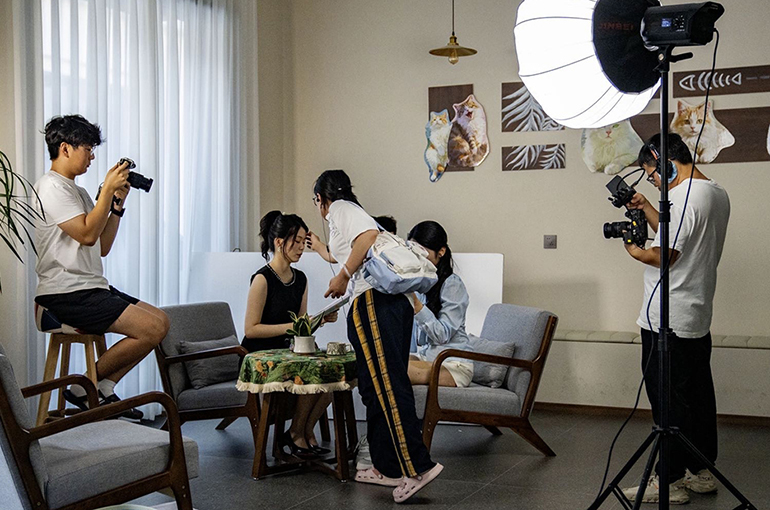
Liu Gangtao, an employee at the Dream Factory Studio Base in Xi’an, said the facility’s filming schedule used to be updated almost weekly last year due to strong demand. As of this month, less than half the schedule board is filled.
“During the busy times last year, there were usually seven or eight production crews filming simultaneously at the base,” Liu said, adding that heavy electricity use sometimes caused unstable voltage and even burned out transformers.
When Yicai visited the site recently, only two production crews were filming, including one long-term client that had signed an annual framework agreement. This agreement category, introduced by the base this year, offers clients about a 40 percent discount compared with standard rental rates.
Managers at several short-drama filming bases in Zhengzhou also told Yicai that while previous years saw constant activity during this period, it is now common to go half a day without seeing a single production crew.
Impact on ‘Short-Drama Capitals’
Several cities without strong traditional film and TV industries rapidly developed into “short-drama capitals,” including Xi’an and Zhengzhou.
According to Xi’an Daily, the city had more than 200 short-video production companies as of 2023, with about 60 percent of China’s micro-short dramas produced there. The boom also led to the development of film bases and industrial parks supporting the upstream and downstream segments of the industry.
But AI is now shaking up the market. Wu Qiang, head of a Xi’an-based short-drama production company, told Yicai that making an 80-episode series used to cost more than CNY300,000 (USD43,570) in actor salaries alone, with total costs exceeding CNY400,000.
Costs can fall to just over CNY100,000 using AI, he said, as there is no need to hire actors or rent props and locations, with a single computer able to complete the work. Actor costs have effectively fallen to near zero, demand for physical filming locations has shifted toward computing power rentals, and post-production editing is increasingly being replaced by algorithms.
Wu added that cities such as Xi’an and Zhengzhou rose quickly as short-drama centers largely because of their relatively low costs for locations, materials, and labor, which enabled low-cost industrialized production. With the rise of AI those cost advantages are disappearing.
Editor: Emmi Laine