


 China’s Consumer Inflation Rises at Faster Pace in September as Factory Gate Prices Hit Over Four-Year High
(Yicai) Oct. 14 -- China's consumer and producer prices both rose at a faster pace last month, buoyed by holiday spending and persistently high energy costs. But while consumer inflation remained subdued, factory gate prices climbed by the most in more than four years.
The consumer price index rose for the second straight month from a year earlier, climbing 0.9 percent in September, versus a 0.8 percent rise the month before, according to data released today by the National Bureau of Statistics. Chief economists polled by the Yicai Research institute had forecast a 1 percent gain.
On a monthly basis, the CPI rose 0.2 percent, slowing from 0.4 percent in August. Excluding energy and food costs, the core CPI increased 1 percent year over year, unchanged on the prior month.
Spending linked with the Mid-Autumn Festival at the end of September and the National Day holiday earlier this month, together with back-to-school spending and seasonal fluctuations in food prices, helped keep consumer inflation broadly stable, Pang Ming, senior researcher at the National Institute for Finance and Development, told Yicai.
The figures suggest that domestic demand is recovering gradually, supported by government policies aimed at boosting consumption, Pang pointed out.
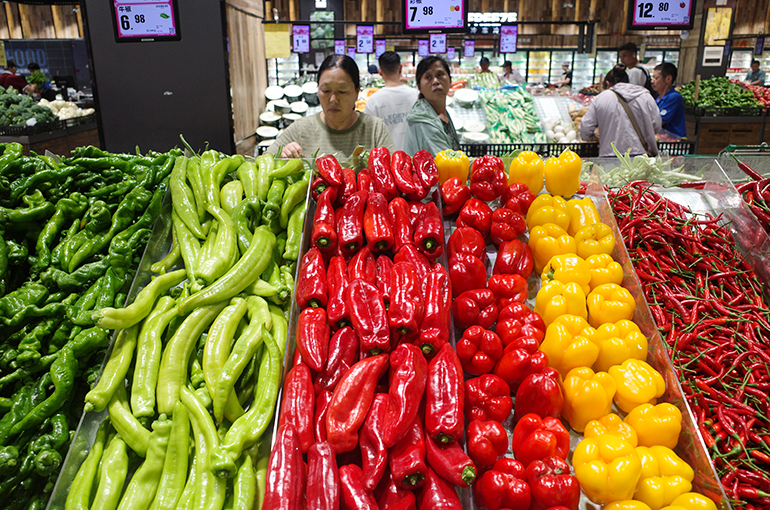
Energy remained the main contributor to consumer inflation. Gasoline prices surged 16.6 percent from a year ago, up from 9.3 percent in August, pushing energy price gains to 7.3 percent from 4.1 percent, the NBS said. In contrast, food prices fell 1.7 percent, with the decline widening from 1.4 percent the previous month, weighing on the CPI by about 0.3 percentage point.
Global oil prices remained elevated early this month and electronics prices went on rising, while food prices are expected to edge up month on month, noted Wang Qing, chief macroeconomic analyst at Golden Credit Rating International. Wang expects October’s CPI to increase by around 1 percent year on year.
The producer price index reached its highest level in September since June 2022, after also rising for the second month in a row from a year ago. The PPI jumped 5 percent, faster than August’s 3.8 percent clip, according to the NBS. The economists surveyed by Yicai had forecast a 4.5 percent increase.
The PPI jumped 1.2 percent month on month, quickening from 0.4 percent in the prior month.
Higher international oil and non-ferrous metal costs pushed up prices across related domestic industries, accounting for much of the increase in September’s PPI, according to NBS statistician Dong Lijuan. Meanwhile, rapid growth in artificial intelligence, computing power, and related sectors boosted demand and prices in some industries, he said.
Both the CPI and PPI figures point to an economic recovery characterised by relatively subdued consumer inflation and relatively strong production, Pang stressed. This suggests that the conditions for profitability in manufacturing and upstream industrial supply chains have improved from earlier levels, although the recovery in demand still needs to gain firmer ground, Pang added.
As policymakers step up economic policy adjustments and implement moderately accommodative monetary measures, the overall level of prices is expected to rise steadily, creating a more favourable price environment for the recovery in business performance and a good start to the 15th Five-Year Plan period that runs through 2030, Pang said.
Editors: Dou Shicong, Martin Kadiev