




 China’s Third-Quarter Jobs Market Was Steady as Urban Employment Rose, Blue Collar Demand Fell
(Yicai Global) Oct. 21 -- China’s labor market was generally stable in the third quarter, as urban employment rose but demand for blue-collar workers fell, according to a gauge of supply and demand.
The CIER Index stood at 2.15 in the three months ended Sept. 30, up from 2.09 in the second quarter and 1.89 a year earlier. That is consistent with the steady decline in the urban unemployment rate tracked by the National Bureau of Statistics.
The CIER Index is a “measure of the degree of tension of the matching between supply and demand in the labor market,” according to the website of the China Institute for Employment Research. “The larger the CIER Index is, the more competitors there are for job vacancies and the more intensive the labor market is. The changes in the CIER Index are affected by the number both of job seekers and job vacancies.”
According to the report the CIER released yesterday, job vacancies and applicants both fell significantly in the third quarter from the prior quarter.
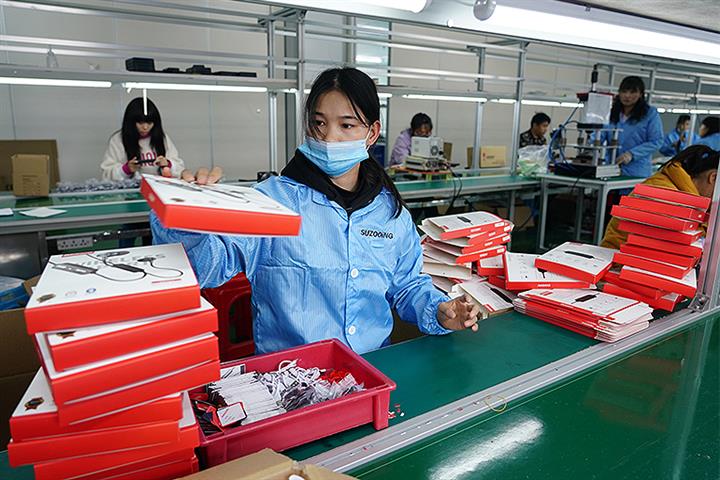
Due to China’s slowing economic growth, vacancies at micro and small companies fell nearly 20 percent, while the blue-collar market had “decreasing demand and rising supply,” said Zeng Xiangquan, the CIER’s director. The blue-collar worker index for micro, small, and private firms fell to the lowest in the past three years, he noted.
From an industry perspective, the education and training sector ranked best in the third quarter, though vacancy and applicant numbers fell because of China’s guidelines to ease the burden of excessive homework and off-campus tutoring for students compulsory education.
From the perspective of industry scale, large companies were doing best, while the employment situation for micro and small businesses was still not optimistic. Recruitment by big firms jumped 125 percent, against a drop of 17 percent and 19 percent at micro and small companies, respectively. Job applications to large firms also rose.
The main challenge in China’s jobs market is imbalance, according to Zhang Chenggang, director of the Research Center for China’s New Employment Patterns at Capital University of Economics and Business. While robust international trade boosted demand in the processing and manufacturing industries, employment in industries impacted by the economic transition and upgrade, tougher regulation, and the pandemic was greatly affected, Zhang said.
Zhang also said China must strive to boost consumption among residents, encourage small and medium-sized businesses to develop and compete better, and improve manufacturing and services by digital means to create more high-quality jobs.
Editor: Futura Costaglione






