



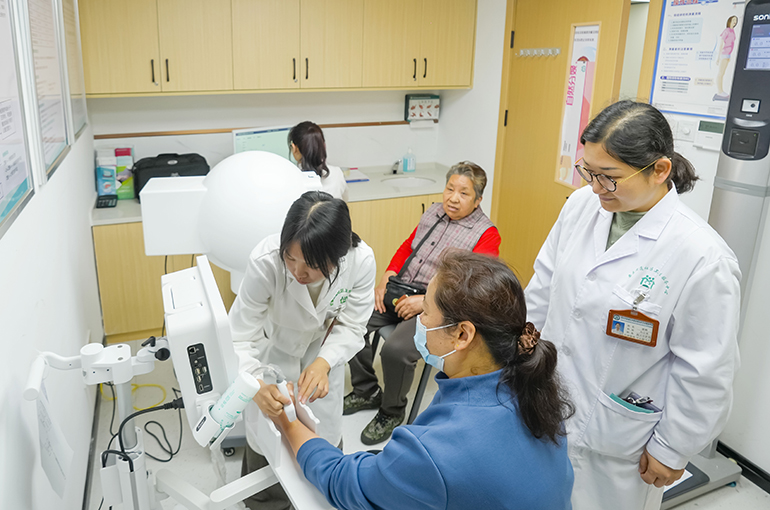
 China Aims for Community Health Centers in Every Urban Sub-District by 2030
(Yicai) June 3 -- China plans to ensure that every urban sub-district has at least one community healthcare center by 2030 so as to enable residents to receive treatment for common illnesses closer to home, according to a policy document released by the National Health Commission yesterday.
To achieve this goal, local governments are encouraged to expand community healthcare services through government procurement programs, where official assessments determine there is a need, private capital is encouraged to establish community medical institutions that fulfill all statutory public service obligations required of standard community health service centers, the NHC said.
A sub-district with more than 100,000 residents may establish an additional community health service center, the authority said.
A sub-district is a basic urban administrative unit in China that usually includes several residential communities. Each sub-district is managed by a local administrative office appointed by district-level governments to provide public services and support community governance.
As an independently operated grassroots public medical institution, a community health service center runs community health service stations, oversees public health programs within its service area, provides standardized practice guidance to local private medical institutions and evaluates their performance.
Community healthcare facilities should expand outpatient services in areas such as pediatrics, dentistry, rehabilitation, mental health, weight management and hemodialysis, according to the NHC document. They are also encouraged to gradually introduce inpatient services, home-based hospital beds as well as home rehabilitation and nursing care.
To bolster healthcare capabilities at the community level, the NHC is encouraging regular staff exchanges between community clinics and public tertiary hospitals. Community healthcare workers are required to receive further training at public hospitals on a periodic basis. In addition, every community health service center must have at least one doctor from a public hospital for regular outpatient consultations.
The document also calls for the adoption of cutting-edge technologies, including artificial intelligence, to enable mutual recognition of lab and imaging test results between grassroots community healthcare centers and higher-tier hospitals. The policy also aims to expand the range of prescription medicines available at community healthcare facilities.
Editors: Tang Shihua, Kim Taylor