



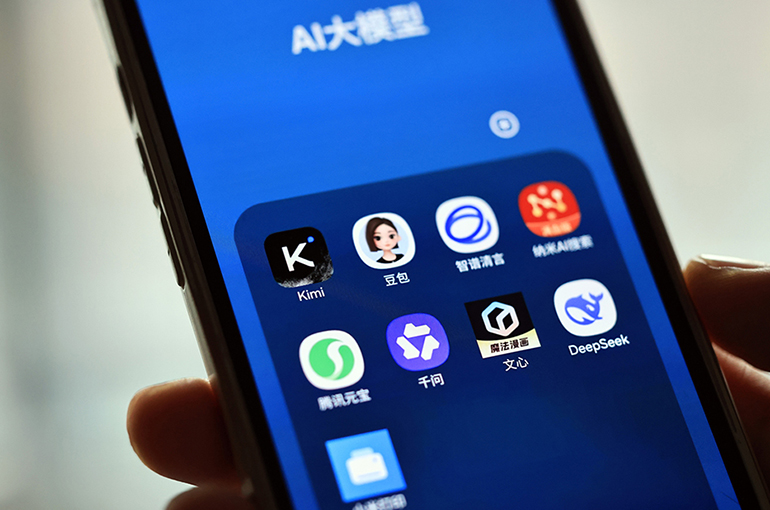
 ByteDance, Other Chinese Tech Giants Target Lunar New Year TV Galas to Push AI Apps
(Yicai) Jan. 29 -- Chinese tech giants such as Tencent Holdings and Alibaba Group Holding are preparing to use China’s Lunar New Year gala broadcasts -- among the country’s most-watched television events -- to pitch their latest artificial intelligence applications to a mass audience.
Tencent, Baidu, and Volcano Engine, the cloud computing unit of TikTok owner ByteDance, recently announced plans to use their AI apps to interact with viewers during Chinese New Year TV spectaculars, offering cash red envelopes to attract users. Alibaba's Qwen assistant has secured the exclusive naming rights for shows to be broadcast by multiple provincial TV stations, including Shanghai Oriental TV.
Advertisers have long competed fiercely for airtime during China Central Television’s New Year’s Gala, one of the country’s most-watched broadcasts. Galas hosted by provincial satellite TV stations also attract large nationwide audiences, particularly those produced in major cities such as Shanghai and Beijing.
“We hope this marketing campaign can recreate the WeChat red envelope moment from the New Year’s Gala 11 years ago,” Tencent Chairman Pony Ma said recently, recalling the CNY500 million (USD71.9 million) giveaway that helped propel rapid adoption of its then-new WeChat Pay service.
The flurry of promotions reflects a broader marketing battle triggered by the recent rollout of many new AI apps. Compared with earlier products, these apps span a wider range of uses and formats, as companies vie for early control over how users access and interact with AI.
ByteDance, for example, is pushing AI beyond software and into hardware. Earlier this month, its workplace platform Feishu launched the AI Recording Bean wearable device, while more than a month ago the company began limited sales of the Nubia M153 -- an AI-powered phone prototype equipped with ByteDance’s Doubao assistant.
Alibaba is seeking to weave Qwen throughout its ecosystem, integrating services such as Taobao, Alipay, Tmall Flash Buy, Fliggy, Amap, Youku, and Freshippo. With a single command, users can order food, book flights, shop, stream video content and receive travel guidance, positioning the AI assistant as a unified front end for Alibaba’s core businesses.
Tencent, meanwhile, has begun testing AI-powered social interaction, aiming to leverage its dominant social platforms to expand the user base of its Yuanbao assistant. However, Ma recently said that the company will not introduce a centralized AI entry in WeChat, opting instead for a decentralized design that lets users decide when and where to activate AI features.
Tencent is also embedding AI into its existing products. Sogou Input Method, which has about 600 million users, recently released an updated version that enhances AI-powered voice input, translation, and typing functions.
By tapping large language models, Sogou can better understand user contexts and reduce missing-word rates by 5 percent to 14 percent across 19 scenarios, including chatting, shopping, and music, Chai Baoquan, who oversees the AI model, told Yicai.
AI voice input supported by Tencent’s Hunyuan speech model has lifted overall recognition accuracy to 98 percent, while the addition of translation models allows Sogou to translate between Chinese and more than 30 languages, Chai noted.
“The shifting boundaries of AI capabilities in input methods depend on user demand and acceptance, and that is a dynamic process,” Chai said. “We won’t limit input methods to the concept of a keyboard, but it’s also difficult to predict what form they will ultimately take.”
The intensifying scramble for AI users comes as China’s initial wave of AI app adoption has largely run its course. As of last June, generative AI applications had 515 million users in China, double the level just six months earlier, with an adoption rate of 37 percent, according to the China Internet Network Information Center.
Editors: Tang Shihua, Martin Kadiev