



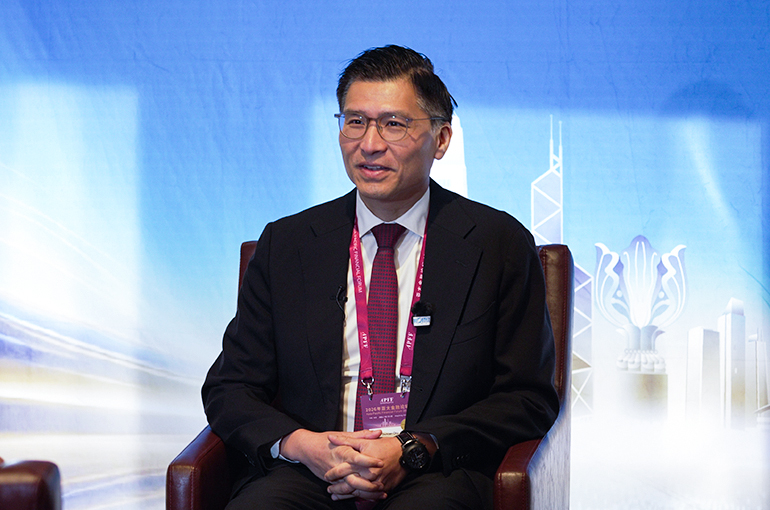
 [APFF 2026] Cross-Border Access Is Next Challenge for Stablecoins After License Issuance, HK Lawmaker Says
(Yicai) Oct. 23 -- Hong Kong's stablecoin regime has moved from legislation to real-world operation, but cross-border access remains the next big challenge, according to a local lawmaker.
Hong Kong has already issued its first two stablecoin licenses, Duncan Chiu, member of the Hong Kong Legislative Council and chair of the Bills Committee that scrutinized the Stablecoins Bill, told Yicai at the 2026 Asia-Pacific Financial Forum.

The licensees are HSBC and Anchorpoint Financial, a joint venture between Standard Chartered, HKT, and Animoca Brands. Anchorpoint's Hong Kong dollar-pegged stablecoin, HKDAP, began a phased roll-out in August, targeting institutional distributors and professional investors. HSBC has named its stablecoin RedCoin, planning to roll it out to retail users through channels such as PayMe.
"Our ordinance is actually quite complete,” Chiu said. “What we're waiting for now is for the two licensees to launch as soon as possible.” With the primary legislation passed, authority over requirements, issuers' financial standing, technical standards, usage rules, and future adjustments has largely been delegated to the Hong Kong Monetary Authority.
Racing to Match US, EU Standards
Chiu described the 2025 deliberations about the Stablecoins Bill as a "race against time," as the United States and European Union were drafting their own stablecoin rules in parallel. The committee's work centered on setting clear safety boundaries for a new financial product and ensuring Hong Kong-issued stablecoins would be tradable internationally.
Many companies, including listed ones, still avoid mainstream stablecoins over safety and legitimacy concerns, Chiu said. “To a large extent, the first thing Hong Kong needs to solve is safety and legitimacy." That is why lawmakers pushed hard on technology and financial-use security during the review.
Interoperability also shaped the rules. Hong Kong closely benchmarked its reserve-asset composition, classification standards, trading conditions, and liquidity requirements against those of jurisdictions that had already legislated on stablecoins, such as the US and EU.
"What matters more is how our stablecoin trades with other countries' stablecoins," Chiu said. Aligning technical standards now should lower the barriers to cross-border trading and interoperability later.
Three Lines of Defense
Regulated stablecoins are like a bridge connecting traditional virtual-asset trading with a widening basket of digital assets, such as tokenized bonds and deposits, with uses spanning everyday payments to international trade settlement, Chiu said.
Before expanding into new use cases, regulators care most about building a track record of safe use, resting on three safeguards: issuers' financial soundness (reserve and capital requirements), transaction security (technical vetting at the licensing stage to prevent hacking or systemic failures), and compliance at the point of use, including anti-money-laundering controls on wallets.
Cross-Border Recognition Is Still a Work in Progress
For companies in the Greater Bay Area and the Chinese mainland, Hong Kong's regulated stablecoins offer a new compliance option for trade settlement. But Chiu was clear about the current limits: licenses apply only within Hong Kong.
Since many Hong Kong-based trading companies deal internationally, and overseas counterparts often want settlement in Hong Kong dollar- or US dollar-linked currencies, a stablecoin pegged to the Hong Kong dollar gives local businesses another efficient payment option.
Scaling across jurisdictions is still unfinished business, Chiu said. The Stablecoins Bill gives the HKMA a mandate, beyond licensing, to help promote Hong Kong's stablecoins abroad and advance interoperability.
"If residents of other countries don't use a stablecoin issued in Hong Kong, there's no market for it,” Chiu noted. “But you can't just go abroad and offer it directly to consumers, you need to meet local legal requirements for mutual recognition, or complete other local procedures, to make it a legal instrument elsewhere too." There is still considerable work ahead for Hong Kong to secure a meaningful share of that market, he pointed out.
In early October, the HKMA and Bank Negara Malaysia agreed to set up a policy-focused working group to explore compliant cross-border stablecoin use cases and deepen cooperation on tokenization and digital currencies. However, that remains at the policy-discussion stage, well short of any formal mutual-recognition arrangement.
Editor: Futura Costaglione